
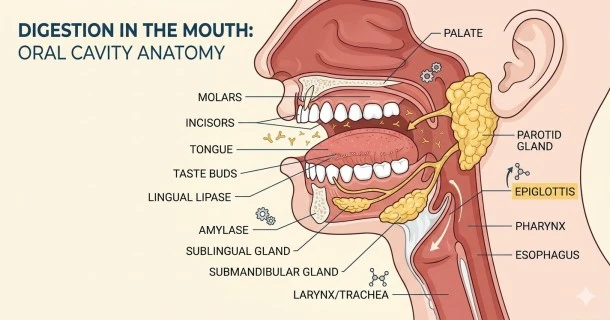
Discover how digestion begins in the mouth. Learn about the roles of teeth, salivary glands, and oral enzymes like salivary amylase in breaking down food.
Digestion in the Mouth: How the Oral Cavity Initiates the Digestive Process
Digestion begins in the mouth, also known as the oral cavity, long before food even reaches the stomach. This critical phase integrates mechanical actions and chemical secretions to convert solid food into a lubricated, easily swallowable mass called a bolus. Failing to properly initiate digestion in the mouth can place excess strain on the rest of the gastrointestinal tract.
Anatomy of the Oral Cavity
The mouth utilizes a specialized structure of bones, muscles, and tissues to break down food efficiently.
The Role of Teeth (Mastication)
Adults typically have 32 specialized teeth designed to mechanically tear, cut, and grind food particles:
- Incisors (8 total): Chisel-shaped front teeth utilized for clean biting and cutting.
- Canines (4 total): Pointed teeth located next to incisors, used for stabbing and tearing.
- Premolars (8 total): Transitional teeth located behind canines, used for initial crushing.
- Molars (12 total): Large flat teeth at the back, responsible for final grinding.
The Tongue and Taste Buds
The tongue is a muscular organ essential for manipulating food, swallowing, and speech. Its upper surface features tiny bumps called papillae, which contain specialized pores known as taste buds. These taste buds transmit neurological signals to the brain to identify sweet, salty, sour, and bitter flavor profiles.
Salivary Glands and Chemical Secretions
Healthy adults secrete approximately 1 to 1.5 liters of saliva daily. The nervous system triggers this production through the thought, sight, or smell of food. Saliva consists of a thin, watery fluid that wets food and a thicker, mucous fluid that binds particles together.
Three primary pairs of exocrine glands produce this fluid:
- Submandibular Glands: Tucked beneath the lower jaw. They generate 70% of total saliva, exporting a mix of thin fluid and thick mucus.
- Parotid Glands: The largest salivary glands, located in front of the ears. They secrete a clear, watery, serous fluid.
- Sublingual Glands: Situated directly underneath the tongue. They contribute roughly 5% of total saliva, producing a highly viscous mucus.
Essential Oral Digestive Enzymes
Chemical digestion starts immediately as saliva mixes with food, introducing two key enzymes:
- Salivary Amylase: Breaks down complex polysaccharides (starches) into simpler disaccharides (maltose).
- Lingual Lipase: Initiates the breakdown of dietary fats, converting lipids into diglycerides and monoglycerides.
The Swallowing and Safety Mechanism
The back of the mouth contains highly coordinated structures that ensure food safely enters the digestive tract rather than the respiratory system.
- Soft Palate and Uvula: Move upward during swallowing to seal off the nasal passages.
- Pharynx: A muscular throat passage that actively propels the food bolus into the esophagus.
- Epiglottis: A flexible cartilage flap located behind the tongue. It acts as a structural lid, automatically folding down during a swallow to cover the larynx (voice box) and protect the windpipe.
Frequently Asked Questions (FAQ)
What enzymes are active during digestion in the mouth?
Two primary enzymes initiate chemical digestion in the mouth. Salivary amylase targets dietary carbohydrates, converting complex starches into simpler maltose sugars. Lingual lipase targets dietary fats, beginning the chemical breakdown of lipids into simpler glycerides.
Which salivary gland produces the most saliva?
The submandibular glands produce the vast majority of human saliva, accounting for approximately 70% of total daily secretions. The parotid glands are the largest in physical size, while the sublingual glands produce the smallest volume at roughly 5%.
How does the epiglottis protect the lungs during swallowing?
The epiglottis functions as an automated safety valve. While breathing, it stands upright to allow airflow into the windpipe. When you swallow, the larynx moves upward and forward, forcing the epiglottis to fold downward, perfectly capping the airway so food and liquids pass safely into the esophagus.