
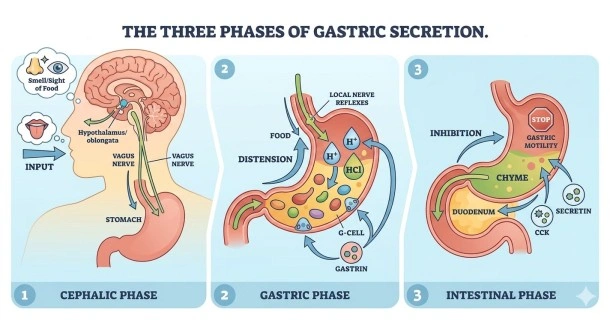
Learn how your body regulates stomach acid. Explore the neural and hormonal triggers behind the cephalic, gastric, and intestinal phases of digestion.
The Three Phases of Gastric Secretion: How Your Stomach Produces Acid
Gastric secretion is the process by which the stomach produces and releases specialized digestive juices—including hydrochloric acid (HCl), pepsinogen, and intrinsic factor—to break down food particles. To ensure acid is only produced when necessary, the body regulates this process in three distinct, overlapping phases: the cephalic phase, the gastric phase, and the intestinal phase.
Understanding how these neural and hormonal pathways interact reveals how your body prepares for, processes, and safely concludes the digestive cycle.
1. The Cephalic Phase: Anticipating the Meal
The cephalic phase of gastric secretion occurs before food even touches your stomach. It is a purely anticipatory phase that primes the gastrointestinal tract for incoming food.
- The Triggers: The sight, smell, taste, or even the thought of food stimulates sensory receptors in the brain.
- The Pathway: These inputs send nervous signals to the hypothalamus and medulla oblongata. The brain then routes parasympathetic impulses down the vagus nerve directly to the enteric nervous system of the stomach.
- The Response: Vagal stimulation prompts parietal cells to secrete hydrochloric acid (HCl) and chief cells to secrete pepsinogen. Simultaneously, it stimulates G-cells to release the hormone gastrin into the bloodstream, which loops back to further drive acid production.
- The Brake System: Because there is no food in the stomach yet to absorb or buffer this fresh acid, the drop in pH causes pancreatic D-cells to release somatostatin. Somatostatin suppresses both parietal and G-cells, keeping acid levels safely in check until food arrives.
2. The Gastric Phase: Processing the Food
The gastric phase is the most active period of digestion, lasting approximately three to four hours. It begins the moment swallowed food drops into the stomach cavity.
- The Triggers: Physical expansion (distension) of the stomach walls and chemical changes caused by the presence of proteins and amino acids.
- The Pathway: Distension activates local stretch receptors, triggering short reflexes within the gut wall and long vagal reflexes through the medulla oblongata to continuously drive the gastric glands.
- The Response: Incoming proteins bind to free hydrogen ions, acting as a natural chemical buffer that elevates the stomach's pH. This rise in pH removes the somatostatin "brake," unleashing a massive surge of gastrin release from G-cells. Gastrin strongly triggers parietal cells to generate hydrochloric acid, lowering the internal stomach pH to a highly acidic 1.0 to 3.0 to activate protein-cleaving pepsin enzymes.
3. The Intestinal Phase: Controlling the Flow
The intestinal phase occurs as partially digested food (chyme) leaves the pyloric sphincter and enters the duodenum. This phase acts largely as an inhibitory feedback loop to slow down the stomach so the small intestine isn't overwhelmed.
- The Triggers: The arrival of highly acidic chyme (pH below 2.0) or chyme rich in lipids (fats) and carbohydrates into the duodenum.
- The Pathway: The duodenum protects itself by turning down the stomach's acid engine through a three-pronged response:
- Neural Inhibition: Signals travel to the medulla oblongata to shut down parasympathetic (vagal) stimulation of the stomach.
- Local Reflexes: Enteric nervous system neurons in the gut wall (the enterogastric reflex) locally suppress gastric motility and secretions.
- Hormonal Control (Enterogastrones): The duodenal mucosa releases localized hormones—specifically Secretin and Cholecystokinin (CCK)—into the bloodstream. These hormones travel back to the stomach to dramatically curb acid production and delay gastric emptying.
Frequently Asked Questions (FAQ)
What are the three phases of gastric secretion?
The three phases of gastric secretion are the cephalic phase (triggered by the thought, smell, or taste of food), the gastric phase (triggered by food entering and stretching the stomach), and the intestinal phase (triggered by chyme entering the small intestine).
How does the vagus nerve influence gastric secretion?
The vagus nerve is the primary parasympathetic pathway connecting the brain to the stomach. During the cephalic and gastric phases, vagal stimulation directly commands parietal cells to release stomach acid and prompts G-cells to release gastrin, amplifying the entire digestive process.
Why does the intestinal phase inhibit gastric secretion?
The intestinal phase inhibits gastric secretion to prevent highly acidic chyme from damaging the duodenal lining and to slow down stomach emptying. This gives the small intestine adequate time to effectively neutralize the acid and absorb nutrients from the food.
What hormone stops acid production in an empty stomach?
During the cephalic phase (before food arrives) and when the stomach empties, D-cells release the hormone somatostatin. Somatostatin acts as a primary physiological brake to inhibit parietal cell acid production and G-cell gastrin release.