
Nutrients
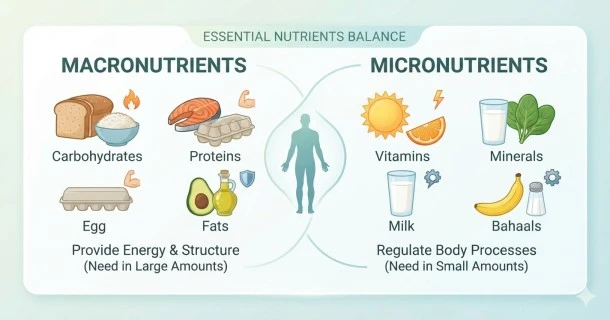
What are the 6 essential nutrients your body needs? Learn the definitive medical difference between macronutrients and micronutrients, their functions, and daily roles.
Human Nutrition: The Comprehensive Guide to Essential Nutrients
Nutrients are chemical substances derived from the food we consume that provide essential nourishment to cellular structures and support overall systemic function. The human body utilizes these compounds to facilitate physiological growth, cellular maintenance, tissue repair, and daily metabolic activities.
A balanced diet abundant in whole, unprocessed foods supports the gastrointestinal tract, optimizes biological nutrient absorption, and acts as a preventative baseline against various clinical conditions. Conversely, chronic nutritional imbalances can lead to distinct health outcomes. A profound deficit in specific elements causes nutrient deficiency diseases (such as scurvy or anemia), whereas systemic overnutrition can contribute to chronic metabolic syndromes and clinical obesity.
Macronutrients vs. Micronutrients: The Core Classifications
Dietary nutrients are broadly categorized into two major groups based on the quantitative amounts the human body requires to survive and function:
| Nutritional Category | General Physiological Function | Required Quantity | Examples |
| Macronutrients | Provide metabolic energy (calories) and serve as structural building blocks. | Large amounts (grams daily) | Carbohydrates, Proteins, Fats, and Water |
| Micronutrients | Act as cofactors for enzymatic reactions, support metabolism, and boost immunity. | Small amounts (milligrams/micrograms daily) | Vitamins and Minerals |
The 6 Essential Classes of Nutrients
A healthy human diet requires six major classes of essential nutrients. While three of these classes supply the body with measurable caloric energy, the remaining three serve critical structural and biochemical regulatory roles.
1. Carbohydrates (Energy Yield: ~4 kcal / 17 kJ per gram)
Carbohydrates are the primary and most accessible source of cellular energy for the human body.
- Chemical Composition: Composed structurally of carbon, hydrogen, and oxygen atoms.
- Classifications: They range from simple monosaccharides (such as glucose, fructose, and galactose) to complex polysaccharides (such as starches).
- Primary Sources: Whole grains, fruits, vegetables, and legumes.
2. Proteins (Energy Yield: ~4 kcal / 17 kJ per gram)
Proteins serve as the fundamental structural building blocks responsible for developing, repairing, and maintaining biological tissues.
- Chemical Composition: Proteins uniquely contain nitrogen atoms alongside carbon, hydrogen, and oxygen. They are formed from chains of organic compounds called amino acids.
- Essential vs. Non-Essential: The human body cannot synthesize certain amino acids internally; these are classified as essential amino acids and must be acquired through diet.
- Metabolic Note: During clinical states of prolonged starvation, the body can convert amino acids into glucose to generate vital energy via a pathway known as gluconeogenesis.
- Primary Sources: Poultry, fish, lean meats, eggs, dairy, tofu, and legumes.
3. Fats and Lipids (Energy Yield: ~9 kcal / 37 kJ per gram)
Dietary fats serve as highly concentrated energy reserves, safeguard internal organs, insulate the body against temperature loss, and facilitate the absorption of vital fat-soluble molecules.
- Chemical Composition: Lipids are primarily structured as triglycerides, which consist of fatty acid monomers bound to a glycerol backbone.
- Classifications: This category encompasses saturated fatty acids, monounsaturated fatty acids, polyunsaturated fatty acids, and essential fatty acids (lipids like Omega-3 and Omega-6 that the body cannot manufacture on its own).
- Primary Sources: Plant-based oils, nuts, seeds, avocados, and fatty fish.
4. Vitamins (Non-Caloric)
Vitamins are organic compounds required in minute quantities to regulate metabolic pathways, fortify the immune response, and support systemic cellular growth.
- Fat-Soluble Vitamins: Vitamins A, D, E, and K. These dissolve in lipids and can accumulate within the body's fat tissues and liver.
- Water-Soluble Vitamins: Vitamin C and the Vitamin B complex (including biotin). These dissolve in water and require consistent dietary replenishment since excess amounts are typically excreted.
5. Minerals (Non-Caloric)
Minerals are inorganic structural and regulatory elements essential for structural integrity, fluid balance regulation, and nerve impulse transmission.
- Macrominerals (Required in larger amounts): Calcium, Chloride, Magnesium, Phosphorus, Potassium, and Sodium.
- Trace Minerals (Required in minute amounts): Iron, Zinc, Copper, Manganese, Fluoride, Iodine, Chromium, Selenium, Molybdenum, Boron, and Cobalt.
6. Water and Dietary Fiber (Non-Caloric)
While they do not yield caloric energy, water and fiber are indispensable to human life.
- Water: The most abundant component of the human body. It acts as a primary vehicle for nutrient transportation, regulates core body temperature, aids in cellular waste removal, and maintains fluid homeostasis.
- Dietary Fiber: Indigestible carbohydrate material that is mechanically and biochemically essential. It promotes healthy gastrointestinal motility, stabilizes blood glucose curves, and helps manage systemic cholesterol profiles.
How the Body Uses Energy
The actual net energy a person derives from macronutrients heavily depends on individual gastrointestinal efficiency, overall digestive health, and cellular absorption rates. Because biochemical processes vary, two individuals consuming the exact same food items may absorb slightly different net caloric values based on their unique gut biomes and metabolic profiles.
Frequently Asked Questions (FAQs)
What is the main difference between macronutrients and micronutrients?
The primary difference is the quantity your body requires daily. Macronutrients (carbohydrates, proteins, fats, and water) are needed in large daily amounts to provide energy and physical structure. Micronutrients (vitamins and minerals) are needed in very small amounts to act as cofactors that trigger metabolic and biochemical processes.
Do micronutrients give you energy?
No. Vitamins and minerals do not contain calories and do not directly produce energy. However, they are completely essential because they act as catalysts that help your body convert macronutrients into usable cellular energy.
What are essential amino acids and fatty acids?
"Essential" means that the human body cannot synthesize these compounds on its own. Because your cells cannot manufacture them from other raw materials, you must obtain them directly through the foods you eat to avoid nutritional deficiencies.
What happens if you get too many or too few nutrients?
A severe shortage of a particular nutrient leads to a deficiency disease (such as iron-deficiency anemia). Conversely, an excessive chronic overconsumption of energy-dense macronutrients can result in overnutrition diseases, which are core drivers of clinical obesity and chronic metabolic syndromes.