
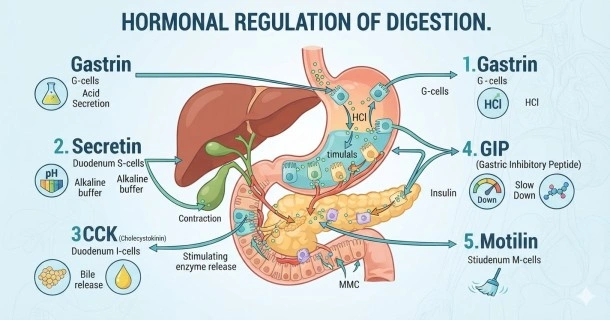
Discover how primary gastrointestinal hormones like Gastrin, Secretin, CCK, GIP, and Motilin regulate acid, enzymes, and appetite to maintain digestive health.
Gastrointestinal Hormones: How They Regulate Your Digestion
Gastrointestinal hormones are specialized chemical messengers that coordinate your digestive system, ensuring food is broken down, nutrients are absorbed, and waste is processed smoothly. Produced by cells within the stomach and small intestine, these hormones travel through the bloodstream to signal the stomach, pancreas, liver, and gallbladder exactly when to release digestive juices and enzymes.
Understanding these primary digestive hormones—Gastrin, Secretin, Cholecystokinin (CCK), Gastric Inhibitory Peptide (GIP), and Motilin—reveals the complex chemical balancing act keeping your gut healthy.
The Big Five: Primary Digestive Hormones and Their Functions
The human gastrointestinal tract relies on five primary endocrine hormones—gastrin, cholecystokinin (CCK), secretin, glucose-dependent insulinotropic peptide (GIP), and motilin—to coordinate nutrient breakdown, enzyme release, and gut motility.
1. Gastrin
- Site of Secretion: Gastrin is produced and secreted by specialized G-cells in the stomach antrum (lower portion of the stomach).
- Triggers for Release: It is stimulated by the arrival of food in the stomach, particularly proteins, peptides, and amino acids, as well as the stretching of the stomach wall and vagal nerve stimulation.
- Primary Function: Gastrin signals the gastric glands to secrete hydrochloric acid (HCl) and pepsinogen to break down food. It also stimulates gastric mucosal growth and gastric motility.
2. Secretin
- Site of Secretion: Secretin is synthesized and released by S-cells located in the duodenum (the first section of the small intestine).
- Triggers for Release: The primary trigger is the entry of highly acidic chyme (semi-digested food mixed with stomach acid) into the duodenum.
- Primary Function: Secretin functions as a natural antacid. It stimulates the pancreas to secrete a bicarbonate-rich fluid that neutralizes the acid chyme. It also prompts the liver to produce bile and inhibits gastric acid secretion.
3. Cholecystokinin (CCK)
- Site of Secretion: CCK is secreted by I-cells in the mucosa of the small intestine, primarily within the duodenum and jejunum.
- Triggers for Release: The presence of fats (lipids) and proteins entering the small intestine strongly stimulates its release.
- Primary Function: CCK triggers the gallbladder to contract, releasing stored bile into the intestine to emulsify fats. Concurrently, it stimulates the pancreas to secrete digestive enzymes (like lipase, amylase, and proteases) and slows down stomach emptying to give the intestine time to absorb nutrients.
4. Gastric Inhibitory Peptide (GIP)
- Site of Secretion: GIP (also known as glucose-dependent insulinotropic peptide) is released by K-cells in the duodenum and jejunum.
- Triggers for Release: It is stimulated by the entry of glucose, amino acids, and fatty acids into the small intestine.
- Primary Function: GIP serves a dual purpose. It inhibits gastric acid secretion and motility (slowing down stomach emptying) when the upper intestine is already full. Crucially, it also acts as an incretin, signaling the beta cells of the pancreas to release insulin in response to incoming carbohydrates.
5. Motilin
- Site of Secretion: Motilin is produced by M-cells in the duodenum and jejunum.
- Triggers for Release: Unlike other digestive hormones, motilin is released cyclically during periods of fasting or between meals.
- Primary Function: Motilin regulates the Migrating Motor Complex (MMC), a periodic wave of electrical activity that moves through the stomach and intestines. This "housekeeping" wave clears out undigested food and debris between meals and stimulates pepsin production.
Hunger and Appetite Regulation: The Gut-Brain Connection
Beyond moving and digesting food, specific GI tract hormones interact directly with the central nervous system to govern how much energy you consume.
- Ghrelin ("The Hunger Hormone"): Synthesized heavily in the stomach wall, ghrelin levels spike when the stomach is empty. It signals the hypothalamus in the brain to trigger feelings of hunger and increase appetite. Once food enters the stomach, ghrelin production drops.
- Peptide YY (PYY - "The Satiety Hormone"): Synthesized by the cells of the ileum and colon, PYY is released into the bloodstream after a meal. It works counter to ghrelin by signaling to the brain that you are full, thereby inhibiting appetite and suppressing further food intake.
Frequently Asked Questions (FAQ)
What is the main function of gastrointestinal hormones?
Gastrointestinal hormones regulate and coordinate the mechanical and chemical processes of digestion. They control the secretion of digestive enzymes, stomach acid, and bile, while also managing the speed at which food travels through the digestive tract and signaling hunger or fullness to the brain.
What triggers the release of secretin?
Secretin is triggered by the presence of acidic chyme entering the duodenum from the stomach. S-cells detect the drop in pH and release secretin to prompt the pancreas to secrete neutralizing sodium bicarbonate.
How do hormones control appetite?
Appetite is primarily regulated by the balance of two key hormones: ghrelin and peptide YY (PYY). Ghrelin is released by an empty stomach to stimulate hunger. Conversely, PYY is released by the intestines after you eat to signal the brain that you are full, suppressing appetite.
Which digestive hormone stimulates gallbladder contraction?
Cholecystokinin (CCK) stimulates the gallbladder to contract, which forces stored bile down into the duodenum to aid in the digestion of fats and proteins.