
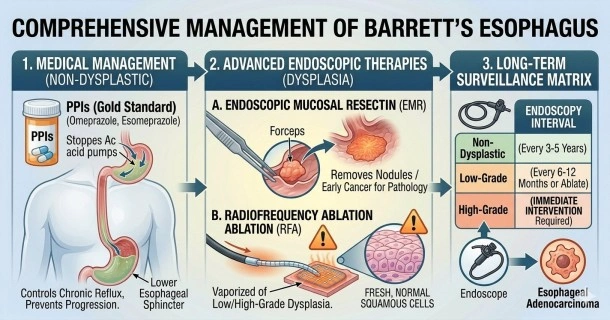
Explore advanced Barrett's esophagus treatment options, including acid suppressants, endoscopic mucosal resection (EMR), ablation therapies, and surgical solutions.
Barrett's Esophagus Treatment, Endoscopic Therapy, and Clinical Surveillance
The clinical approach to Barrett's esophagus treatment is multi-tiered and determined by the degree of cellular abnormality (dysplasia) found during pathology reviews. Because the cellular transformation of intestinal metaplasia cannot be reversed with standard pill medications, medical therapy focuses heavily on stopping ongoing acid damage, while advanced endoscopic interventions are used to actively destroy or remove abnormal precancerous cells.
1. Medical Management and Acid Suppression
For patients diagnosed with Non-Dysplastic Barrett's Esophagus (no precancerous changes present), treatment relies on strict medical management to keep stomach acid from irritating the altered tissue lining.
Proton Pump Inhibitors (PPIs)
PPIs are the gold standard medical treatment for controlling the chronic reflux that drives tissue changes. They work by shutting down the chemical pumps in the stomach that produce acid.
- Frontline Clinical Options: Omeprazole, lansoprazole, pantoprazole, rabeprazole, and esomeprazole. These are typically prescribed as high-dose daily regimens to maximize tissue healing.
H2 Receptor Antagonists (H2 Blockers)
Used primarily as secondary or nighttime adjunctive therapies for patients requiring extra acid control.
- Frontline Options: Famotidine and cimetidine.
Critical Safety Status on Historical Medications
- Ranitidine (Zantac) Warning: Ranitidine has been permanently recalled and completely discontinued globally due to contamination risks with NDMA, a probable human carcinogen. It is no longer a valid medical option.
- Metoclopramide (Reglan) Limitations: While this medication can increase lower esophageal sphincter pressure, its severe neurological risk profile (such as tardive dyskinesia) heavily restricts its long-term use. It is never used as a frontline monotherapy for Barrett's esophagus.
2. Advanced Endoscopic Therapies for Dysplasia
When a biopsy reveals low-grade or high-grade dysplasia, meaning the cells have begun mutating toward cancer, gastroenterologists use targeted endoscopic techniques to remove or eradicate the abnormal tissue layers.
Endoscopic Mucosal Resection (EMR)
EMR is a precise structural procedure used to remove visible nodules, raised lesions, or early localized cancer cells from the lining of the digestive tract.
- The Procedure: The physician passes specialized instruments through an endoscope to inject a fluid cushion under the abnormal tissue, lifting it away from the deeper muscular walls. The abnormal tissue layer is then carefully suctioned, cut, and removed for comprehensive pathology analysis.
Radiofrequency Ablation (RFA)
RFA has largely replaced older thermal methods like Photodynamic Therapy (PDT) due to its high precision and low rate of complications.
- The Procedure: A specialized balloon or focal catheter equipped with an electrical grid is guided to the target tissue. It delivers controlled bursts of heat energy to vaporize the thin, superficial layer of abnormal salmon-colored mucosa. Over the following weeks, the body heals by growing fresh, normal squamous cells in its place.
3. Surgical Options and Anti-Reflux Procedures
If a patient fails to respond to endoscopic management, suffers from severe tissue mutations across the entire esophagus, or has major mechanical failures of the lower stomach valve, surgery may be considered.
Laparoscopic Fundoplication
This anti-reflux surgery does not alter the Barrett's tissue itself, but it mechanically repairs a weak lower esophageal sphincter (LES). The surgeon wraps the upper portion of the stomach (the fundus) completely around the lower esophagus to create a secure, one-way valve that stops acid from washing upward.
Esophagectomy
An invasive surgical procedure reserved almost exclusively for healthy patients who have progressed to widespread high-grade dysplasia or invasive esophageal cancer. It involves surgically removing the damaged section of the esophagus and pulling a portion of the stomach up into the chest cavity to restore the digestive tract.
4. The Role of Long-Term Clinical Surveillance
Because Barrett's esophagus carries a statistical risk of mutating into esophageal adenocarcinoma, long-term clinical surveillance is a mandatory component of management. The frequency of repeat upper endoscopies and systematic mapping biopsies is strictly determined by the grade of dysplasia:
| Dysplasia Status | Recommended Surveillance Interval |
|---|---|
| Non-Dysplastic | Repeat upper endoscopy every 3 to 5 years. |
| Low-Grade Dysplasia | Repeat evaluation every 6 to 12 months, or proceed directly to endoscopic ablation therapies. |
| High-Grade Dysplasia | Requires immediate intervention via EMR, ablation, or surgical resection to prevent progression to cancer. |
Frequently Asked Questions (FAQs)
Can medication completely cure or get rid of Barrett's esophagus?
No medication can cure, reverse, or dissolve Barrett's esophagus tissue once the cells have mutated into intestinal metaplasia. Medications like Proton Pump Inhibitors (PPIs) are prescribed solely to eliminate stomach acid, which keeps the condition stable and stops the cells from mutating further.
What is the difference between EMR and Ablation (RFA)?
Endoscopic Mucosal Resection (EMR) is a procedure used to physically cut out and remove thick, raised nodules or abnormal tissue samples from the esophagus so they can be studied under a microscope. Radiofrequency Ablation (RFA) uses targeted heat energy to safely vaporize flat patches of abnormal tissue without removing them.
Is ranitidine (Zantac) still used to treat Barrett's esophagus?
No. Ranitidine has been permanently withdrawn from medical use globally due to safety concerns regarding unacceptable levels of a cancer-causing chemical called NDMA. Modern treatment protocols rely strictly on safer alternatives, such as famotidine or frontline proton pump inhibitors.