
Learn how the esophagus works, discover common esophageal diseases like GERD and achalasia, and find out when to seek medical evaluation for swallowing issues.
Introduction to Esophagus and Esophageal Diseases
The esophagus is a muscular tube that plays a vital role in the digestive system by transporting food, liquids, and saliva from the mouth to the stomach. While it typically functions seamlessly, various esophageal diseases can disrupt this pathway, leading to discomfort, difficulty swallowing, or more severe health complications. Understanding the anatomy of the esophagus and the types of disorders that can affect it is the first step toward recognizing when a medical evaluation may be necessary.
Anatomy and Function of the Esophagus
To understand esophageal disorders, it helps to look at how the organ is built to handle the daily passage of food and liquids.
Cellular Lining and Protection
The inner surface of the esophagus is lined with stratified squamous epithelium. This specialized, multi-layered tissue is highly resilient, protecting the organ against rough or abrasive food particles. Additionally, mucous glands embedded within the mucosal layer secrete mucus, which acts as a natural lubricant to facilitate smooth transit into the stomach.
The Esophageal Sphincters
The coordinated movement of food relies on two main muscular valves:
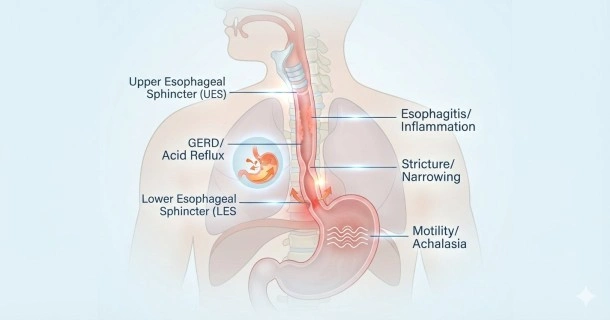
- Upper Esophageal Sphincter (UES): Located at the top of the esophagus, near the larynx (voice box). When you swallow, this sphincter relaxes to allow food to enter the esophagus while preventing it from entering the airway. If food accidentally enters the air passage, the body's natural defense mechanism triggers a violent cough reflex to expel the particle.
- Lower Esophageal Sphincter (LES): Located at the junction where the esophagus meets the stomach. This ring of muscle relaxes to let food pass into the stomach and then tightly closes to keep highly acidic gastric juices from flowing backward. If the LES weakens or relaxes inappropriately, acid reflux may occur, frequently causing a burning sensation known as heartburn.
Common Types of Esophageal Diseases
Esophageal disorders generally fall into a few primary categories based on whether they involve inflammation, structural changes, motility issues, or infectious agents.
Inflammatory and Reflux Disorders
- Esophagitis: A general term indicating inflammation, irritation, or swelling of the tissue lining the esophagus.
- Gastroesophageal Reflux Disease (GERD): A chronic condition where stomach acid frequently flows back into the esophagus, potentially causing regular heartburn and mucosal damage.
- Barrett’s Esophagus: A complication of chronic GERD where the normal squamous lining changes into tissue resembling the lining of the intestine, requiring careful medical monitoring due to an associated risk of esophageal cancer.
Structural and Mechanical Disorders
- Benign Esophageal Stricture: A gradual narrowing or tightening of the esophagus, often resulting from scar tissue built up due to chronic acid reflux, which can cause progressive swallowing difficulties.
- Esophageal Perforation: A serious, life-threatening medical emergency involving a tear or hole in the wall of the esophagus.
- Mallory-Weiss Tear: A laceration or tear in the mucous membrane at the junction of the stomach and esophagus, often triggered by severe vomiting or straining.
Motility and Functional Disorders
- Dysphagia: The medical term for difficulty swallowing, which can serve as a primary symptom for many structural or muscular esophageal conditions.
- Achalasia: A rare motility disorder where the lower esophageal sphincter fails to relax properly and the normal wave-like muscle contractions (peristalsis) of the esophagus are diminished, making it difficult for food to enter the stomach.
- Esophageal Spasms: Painful, uncoordinated muscular contractions of the esophagus, sometimes described visually on imaging tests as a "corkscrew" or "rosary bead" esophagus.
- Esophageal Diverticula: Outpouchings or pockets that form in the esophageal wall (such as Zenker's diverticula), which can trap food and lead to swallowing difficulties or bad breath.
Infectious and Other Conditions
- Infectious Esophagitis: Tissue inflammation caused by pathogens, most commonly seen in immunocompromised individuals. Examples include fungal infections like Candida esophagitis, or viral infections like Cytomegalovirus (CMV) esophagitis and Herpes esophagitis.
- Bleeding Esophageal Varices: Enlarged, fragile veins in the lower esophagus that develop primarily due to severe liver disease (portal hypertension) and carry a high risk of life-threatening bleeding.
- Esophageal Atresia: A congenital birth defect where the esophagus forms in two disconnected segments rather than a continuous tube.
Frequently Asked Questions (FAQs)
What is the most common disease of the esophagus?
Gastroesophageal Reflux Disease (GERD) is widely considered the most common disorder affecting the esophagus. It occurs when the lower esophageal sphincter relaxes inappropriately, allowing stomach acid to back up into the esophageal lining and cause chronic heartburn or irritation.
What does it feel like when something is wrong with your esophagus?
People with an esophageal disorder frequently report difficulty swallowing (dysphagia), a sensation that food is stuck in their chest, chronic heartburn, a sour taste in the back of the mouth, or unexplained chest pain. Because chest discomfort can also indicate cardiac issues, sudden or severe chest pain should always be evaluated by an emergency medical professional.
Can an esophageal disorder be cured?
Many esophageal conditions, such as mild esophagitis or strictures, can be highly manageable or effectively resolved with lifestyle adjustments, medications, or minimally invasive procedures like dilation. Chronic conditions like Barrett's esophagus or achalasia generally cannot be completely cured, but their symptoms and risks can be managed well under long-term medical supervision.
When should I see a doctor for swallowing issues?
You should seek medical evaluation if you experience persistent difficulty swallowing, painful swallowing, unexplained weight loss, choking episodes, or if you frequently feel like food is lodged in your throat or chest.