
Discover how the stomach breaks down food. Learn about stomach anatomy, mechanical churning, gastric acid (HCl), pepsin enzymes, and how chyme is formed.
The Stomach's Role in Digestion: Anatomy, Function, and Process
The stomach serves as a vital, highly expandable muscular organ within the human digestive system, functioning primarily to store, mechanically churn, and chemically break down ingested food. Acting as an intermediate bridge between the esophagus and the small intestine, it transforms a swallowed food bolus into a semi-liquid mixture known as chyme. Understanding the precise mechanisms of gastric digestion, stomach acid regulation, and muscular motility reveals how our bodies prepare nutrients for final absorption.
Anatomy of the Human Stomach
The stomach is a flexible, J-shaped pouch located in the upper left quadrant of the abdominal cavity. In a well-developed adult, an empty stomach has a volume of approximately 45 ml to 50 ml, but its highly distensible walls can stretch comfortably to hold 1 to 2 liters of food, and occasionally up to 3 liters under extreme distension.
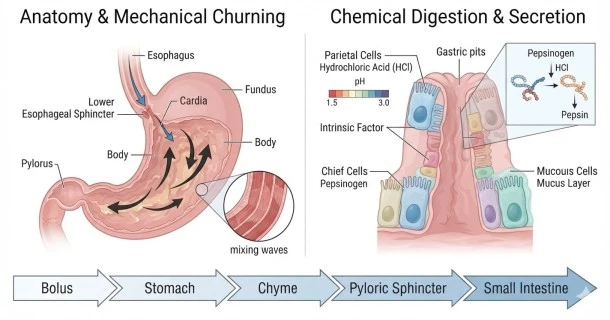
Anatomically, the stomach is divided into four primary regions:
- Cardia: The superior opening surrounding the cardiac orifice, where food enters from the esophagus.
- Fundus: The rounded, dome-shaped upper portion situated to the left of the cardia, which frequently collects swallowed gases.
- Body (Corpus): The largest, central region of the stomach where the majority of chemical digestion and mixing occurs.
- Pylorus: The funnel-shaped lower region consisting of the pyloric antrum and pyloric canal. It terminates at the pyloric sphincter, a thick ring of smooth muscle acting as a valve to regulate the release of chyme into the duodenum (the first part of the small intestine).
How the Stomach Digests Food: The Two-Step Process
Digestion within the stomach involves a synchronized combination of mechanical and chemical processes.
1. Mechanical Digestion and Motility
When a food bolus travels down the esophagus and passes through the lower esophageal sphincter, it triggers coordinated muscular contractions in the stomach wall. The stomach features three distinct layers of smooth muscle (circular, longitudinal, and oblique) that generate three major movement patterns:
- Mixing Waves: Slow, rhythmic contraction waves begin in the upper stomach and travel downward, pushing food back and forth to physically crush and mix it with gastric juices.
- Peristaltic Propulsion: Deeper contractions move toward the pyloric sphincter, building up intragastric pressure to intermittently push small amounts of liquefied chyme through the narrow pyloric valve.
- Tonic Contractions: Continuous, slow contractions gradually decrease the total size of the stomach lumen as it empties.
2. Chemical Digestion and Gastric Secretion
The specialized stomach lining (mucosa) is densely populated with gastric pits containing specialized secretory cells. Together, they secrete highly acidic gastric juice:
- Parietal Cells: These cells secrete hydrochloric acid (HCl) and intrinsic factor (necessary for Vitamin B12 absorption). HCl lowers the internal gastric pH to approximately 1.5 to 3.0. This severe acidity serves two crucial roles: it denatures complex dietary proteins and kills or inhibits most ingested bacteria and microorganisms.
- Chief Cells: These cells release an inactive enzyme precursor called pepsinogen. When exposed to the highly acidic environment created by HCl, pepsinogen activates into pepsin, a powerful protease enzyme that chemically cleaves proteins into smaller peptide chains.
- Mucous Cells: To prevent the stomach from digesting its own tissue, these cells secrete a thick, bicarbonate-rich mucus layer that acts as a physical and chemical buffer against the corrosive acid and pepsin.
Depending on the volume and macronutrient composition of a meal, the stomach will typically process food into chyme over a period ranging from 40 minutes to a few hours. Liquids leave the stomach rapidly, carbohydrates move quickly, proteins take longer, and fats require the longest processing time before passing into the small intestine.
Phases of Gastric Secretion
The production of gastric juices does not happen all at once; it is tightly regulated by both neural pathways (the vagus nerve) and hormonal signals (such as gastrin) across three overlapping phases:
- The Cephalic Phase: Triggered purely by the sight, smell, taste, or thought of food. The brain sends signals down the vagus nerve to prime the stomach by initiating basic acid and enzyme secretion before food even arrives.
- The Gastric Phase: Activated when food physically enters the stomach, causing the walls to stretch (distension) and raising the internal pH. This stimulates local reflexes and causes G-cells to release the hormone gastrin, which exponentially drives up acid production to handle the incoming meal.
- The Intestinal Phase: Triggered as chyme begins emptying into the duodenum. The presence of acid and fats in the small intestine sets off inhibitory mechanisms, releasing hormones like secretin and cholecystokinin (CCK) to slow down gastric emptying and suppress further acid secretion, ensuring the small intestine is not overwhelmed.
Frequently Asked Questions (FAQs)
What is the primary function of the stomach in the digestive system?
The primary function of the stomach is to act as a temporary food reservoir where mechanical churning and chemical breakdown convert solid food into a semi-liquid mass called chyme. It initiates protein digestion using specialized enzymes and acts as a protective barrier against ingested pathogens.
Why doesn't stomach acid digest the stomach itself?
The stomach protects itself from its highly acidic environment by secreting a thick, viscous layer of alkaline mucus. This mucous barrier contains bicarbonate ions that neutralize hydrochloric acid right at the surface of the stomach lining, preventing chemical burns and auto-digestion.
What is chyme, and how long does it stay in the stomach?
Chyme is the semi-fluid mixture of partially digested food, water, and gastric secretions formed by the mechanical churning of the stomach. Food typically remains in the stomach between 40 minutes to several hours, depending on its composition. Simple carbohydrates leave quickly, while high-fat and high-protein meals take much longer to empty.
What role does the pyloric sphincter play?The pyloric sphincter is a smooth muscle valve located at the base of the stomach. It controls the rate of gastric emptying by allowing only tiny amounts of chyme to pass into the duodenum at a time, while simultaneously preventing the harsh, alkaline contents of the small intestine from backing up into the stomach.