
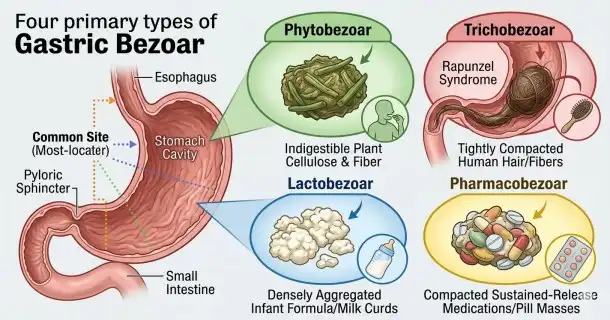
Learn about gastrointestinal bezoars. Explore the different types—including phytobezoars and trichobezoars—and how they form trapped masses in the stomach.
What is a Bezoar?
A bezoar (pronounced BE-zor) is a tightly compacted mass of partially digested or completely undigested foreign material that becomes physically trapped within the gastrointestinal tract.
While these obstructive masses can technically travel down into the small or large intestines, the stomach is statistically the most common site for a bezoar to take root. This occurs primarily due to the unique, curved anatomical shape of the gastric cavity and the tightly restricted opening of the pyloric sphincter, which makes it highly difficult for a dense solid mass to pass naturally into the small bowel.
The Four Major Types of Bezoars
Medical professionals classify gastrointestinal bezoars into distinct types based on their raw composition:
1. Phytobezoars (Plant Fiber Masses)
This is the most common type of bezoar diagnosed in adults.
- The Triggers: They are composed entirely of indigestible plant cellulose, lignin, and fibers found in fruits and vegetables.
- Vulnerable Groups: They develop most frequently in individuals with compromised digestive tracts, poor tooth structure leading to inadequate chewing, or low stomach acid production.
2. Trichobezoars (Hairballs in Humans)
Trichobezoars are masses composed almost entirely of hair or hair-like synthetic fibers.
- The Triggers: Human hair cannot be broken down by gastric juices or stomach acid.
- Vulnerable Groups: This type typically develops in young children or individuals struggling with underlying psychiatric disorders—such as trichotillomania (compulsive hair pulling) and trichophagia (compulsive hair eating).
3. Lactobezoars (Thickened Milk Clumps)
Lactobezoars consist of densely compacted, undigested milk curds and infant formula aggregates.
- Vulnerable Groups: This variation is found almost exclusively in premature infants or newborns who are receiving highly concentrated, calorie-dense formula mixtures.
4. Pharmacobezoars (Compacted Medication Masses)
Pharmacobezoars are solid masses made up of undissolved medications or pill coatings.
- The Triggers: They are usually caused by severe drug overdoses or the heavy consumption of extended-release, enteric-coated, or long-lasting medications that stick together inside the gastric juices.
Navigate Our Comprehensive Bezoar Guides
Because treating an internal blockage requires careful clinical management, we have developed deep-dive, dedicated resources to help you find your exact answers:
- Recognize Potential Symptoms: Read about the signs of a gastric mass, including early fullness, abdominal bloating, chronic nausea, and gastric ulcer formation.
- Explore Root Causes: Learn the cellular mechanics of how inadequate gastric motility and indigestible substances create physical plugs.
- Identify Primary Risk Factors: Discover how past gastric bypass surgeries, diabetes-related gastroparesis, and low stomach acid elevate your risk.
- Understand Key Triggers: Examine external factors, such as high-fiber dietary changes or specific medication combinations, that initiate mass growth.
- Diagnosis & Imaging Scans: Find out how specialists identify masses utilizing standard abdominal X-rays, CT scans, and diagnostic endoscopies.
- Treatment & Removal Options: Learn how medical teams dissolve or fragment bezoars using chemical solutions, endoscopic tools, or surgical extraction.
Frequently Asked Questions (FAQs)
Where does the strange word "bezoar" come from?
The word bezoar is derived directly from an ancient Persian word meaning "antidote." Centuries ago, people mistakenly believed that animal bezoars possessed magical properties capable of neutralizing any poison poured into a drinking glass. This myth was scientifically debunked by surgeons in the late 1500s.
Why does a stomach blockage cause "early satiety" (early fullness)?
When a bulky mass like a phytobezoar or a trichobezoar takes up significant physical space inside your stomach cavity, it prevents the stomach from expanding normally to accommodate food. As a result, you will feel completely stuffed, bloated, or nauseous after swallowing only a few bites of a meal.
Can a human naturally digest a hairball (trichobezoar)?
No, human hair is entirely resistant to the chemical enzymes and hydrochloric acids produced within the human digestive system. Once hair is swallowed, the constant churning movements of the stomach cause it to mesh together into a dense, felt-like trap that can only be safely extracted via an endoscopy or surgery.