
Learn the 4 main types of dietary fats, the difference between saturated and unsaturated fats, and why lipids are essential for brain and hormone health.
Understanding Dietary Fats: Structure, Classifications, and Health Roles
Fats, scientifically referred to as lipids, are essential macronutrients required to sustain basic human life and optimize physiological health. Far from being simple structural elements, lipids serve as concentrated energy stores, provide foundational building blocks for cellular architecture, and assist other vital nutrients in executing their biological pathways.
Defining Fats, Oils, and Lipids
While the words fat, oil, and lipid are frequently used interchangeably in daily conversation, they have distinct chemical and physical definitions based on their molecular structures and behaviors at room temperature (approximately 20°C or 68°F):
- Lipids: The broad chemical umbrella term for all hydrophobic organic molecules, encompassing solid fats, liquid oils, waxes, sterols, and fat-soluble vitamins.
- Fats: Lipids that maintain a solid or semi-solid physical state at room temperature (typically high in saturated fatty acids, like butter or lard).
- Oils: Lipids that remain in a liquid physical state at room temperature (typically high in unsaturated fatty acids, like olive or sunflower oil).
From a chemical perspective, most dietary lipids exist structurally as triglycerides, which consist of three fatty acid chains chemically bound to a central glycerol backbone.
Dietary Fats Classification: The Four Main Types
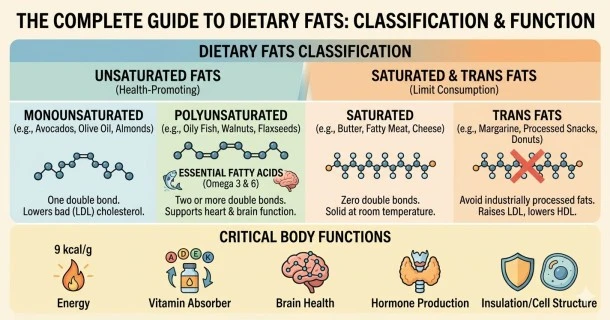
Dietary fats are classified according to the presence and number of double bonds within their fatty acid carbon chains. This structural difference directly dictates their physical properties and their impact on cardiovascular profiles:
| Fat Type | Molecular Structure | Impact on Cholesterol Profiles | Primary Food Sources |
| Monosaturated Fats | Contains exactly one carbon-to-carbon double bond; liquid at room temp. | Lowers atherogenic LDL (bad) cholesterol; preserves or raises HDL (good) cholesterol. | Olive oil, avocados, canola oil, almonds, and cashews. |
| Polyunsaturated Fats | Contains two or more carbon-to-carbon double bonds; liquid at room temp. | Reduces systemic LDL cholesterol; provides crucial essential fatty acids the body cannot synthesize. | Omega-3: Salmon, walnuts, flaxseeds. Omega-6: Sunflower oil, corn oil, soybean oil. |
| Saturated Fats | Contains zero carbon-to-carbon double bonds; solid at room temp. | Can elevate total and LDL cholesterol markers when consumed in chronic excess. | Fatty meats, lard, butter, cheese, and tropical lipids like coconut oil. |
| Trans Fats | Industrially modified via partial hydrogenation to change oil configurations. | Severely elevates atherogenic LDL cholesterol while actively dropping beneficial HDL cholesterol. | Margarine, commercial vegetable shortenings, fried fast foods, and packaged pastries. |
Why Lipids Are Critical for Body Function
Despite their mixed public reputation, fats are biochemically essential for human health. Medical guidelines recommend that 20% to 35% of daily caloric intake should come from healthy dietary fats.
- Concentrated Caloric Energy: Fats represent the body’s most energy-dense macronutrient, delivering 9 calories per gram. This is more than double the energy density of carbohydrates or proteins (which both supply 4 calories per gram).
- Neurological Structure: The human brain is composed largely of lipids. Fats provide the essential structural integrity for neuronal cell membranes and the myelin sheath—the insulating layer around nerve fibers that ensures rapid electrical impulse transmission.
- Vitamin Co-Factors: The digestion and assimilation of fat-soluble vitamins (Vitamins A, D, E, and K) rely entirely on the presence of dietary lipids in the intestinal tract. Without sufficient fat, these vitamins cannot be effectively absorbed.
- Hormonal and Cellular Integrity: Lipids form the structural lipid bilayer of every single cell membrane in the human body. They also serve as the structural precursors for synthesizing vital hormones, including steroid and sex hormones.
- Mechanical Cushions and Insulation: Subcutaneous adipose tissue acts as a natural insulator to regulate core body temperature. Visceral fat pads provide mechanical shock absorption to buffer internal visceral organs against external physical impacts.
Do Fats Make You Fat? The Caloric Truth
(Medical Correction: Clarifying the distinction between dietary fat consumption and adipose tissue storage).
Consuming dietary fat does not inherently cause obesity. Weight gain and adipose tissue expansion occur when a person experiences a chronic caloric surplus—consuming more total energy than the body expends over an extended period.
When total caloric intake from carbohydrates, proteins, or fats exceeds daily metabolic expenditures, the body converts the excess energy into triglycerides and stores them within fat tissue for future metabolic needs.
Frequently Asked Questions (FAQs)
What is the main difference between saturated and unsaturated fats?
The primary difference lies in their chemical structure and physical state. Saturated fats lack carbon-to-carbon double bonds, pack tightly together, and remain solid at room temperature. Unsaturated fats contain one or more double bonds, which creates bends in their structure, keeping them liquid at room temperature.
Why does the body need essential fatty acids like Omega-3 and Omega-6?
They are called "essential" because the human body lacks the enzymes required to synthesize them from scratch. Because they are critical for brain function, immune health, and cellular repair, you must obtain them directly from food sources like oily fish, nuts, and plant oils.
How do fats help with vitamin absorption?
Vitamins A, D, E, and K are fat-soluble molecules. This means they cannot dissolve in water and require dietary fats to be broken down, carried through the digestive tract, and absorbed across the lining of the small intestine.
Are trans fats dangerous for heart health?
Yes. Industrially manufactured trans fats are highly damaging because they simultaneously raise LDL (bad) cholesterol and lower HDL (good) cholesterol. This distinct shift significantly increases the risk of plaque buildup in the arteries and long-term cardiovascular disease.