
Discover the vital functions of proteins in the human body. Learn the difference between complete and incomplete proteins, amino acids, and daily requirements.
Understanding Proteins: Structure, Amino Acids, and Biological Importance
Protein is a foundational macronutrient that participates in virtually every biochemical process within a living cell. Unlike carbohydrates and lipids, which primarily serve as metabolic fuels, proteins act as the functional and structural machinery of the human body. They are continuously utilized to build, maintain, and repair vital structures like bones, muscle fibers, and skin tissues.
What Are Proteins? The Amino Acid Building Blocks
Proteins are large, complex organic polymers composed of thousands of smaller structural units called amino acids. These amino acids chemically link together into long, sophisticated peptide chains.
There are 20 distinct types of amino acids that combine in unique variations to construct every protein molecule needed by the human body. The exact sequence of these amino acids dictates the specific folding pattern, three-dimensional shape, and biological function of each individual protein.
[Amino Acids] ──(Linked into Peptide Chains)──► [3D Protein Structure] ──► [Biological Function]
Essential vs. Non-Essential Amino Acids
(Medical Correction: While the original text listed 10 essential amino acids, modern adult clinical nutrition explicitly identifies 9 strictly essential amino acids, with others being conditionally essential during growth, pregnancy, or trauma recovery).
- Essential Amino Acids: The human body cannot synthesize these amino acids internally. Because cells cannot manufacture them, they must be consistently supplied through your daily diet.
- Non-Essential Amino Acids: The body possesses the metabolic pathways to build these compounds internally from other raw materials, making direct dietary consumption less critical.
Complete vs. Incomplete Proteins
Dietary protein sources are categorized based on their total amino acid profile:
| Protein Category | Definition | Key Characteristics | Common Dietary Sources |
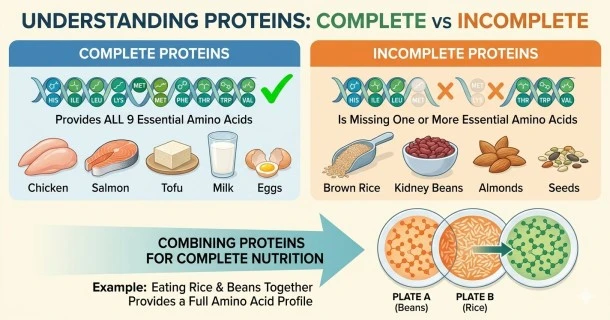
| Complete Proteins | Contains all of the essential amino acids in adequate structural proportions. | Highly bioavailable; primarily derived from animal products. | Poultry, beef, fish, eggs, dairy products (milk, cheese), and soy (tofu). |
| Incomplete Proteins | Lacks one or more of the essential amino acids required for protein synthesis. | Typically derived from plant sources; can be combined to form a complete profile. | Grains (barley, brown rice, oatmeal), legumes, nuts, seeds, and vegetables. |
6 Vital Functions of Proteins in the Human Body
Proteins are the workhorses of cellular biology, executing a vast array of critical functions:
- Structural Integrity: Form the physical scaffolding for muscles, skin layers, connective tissues, and hair structures (primarily via proteins like collagen and keratin).
- Enzymatic Catalysis: Act as enzymes that drive thousands of vital metabolic and chemical reactions throughout the body every second.
- Immune Protection: Construct specialized antibodies that recognize and bind to invasive viruses and bacteria, neutralizing pathogens to defend the body.
- Hormonal Messengers: Serve as hormonal signaling molecules (such as insulin) that coordinate intricate biological activities across distant organs.
- Molecular Transport: Act as cellular transport vehicles that bind to and move atoms, ions, and small molecules across cell membranes and throughout the bloodstream.
- Cellular Maintenance: Supply the raw nitrogen and sulfur compounds required to build new cells, format DNA/RNA, and continuously replace worn-out tissues<─>.
Daily Protein Requirements: The Caloric Reality
(Medical Correction: Clarifying the distinction between protein processing and storage).
Because the human body maintains no specialized, passive reservoir to store excess amino acids (unlike the way it stores fat in adipose tissue or carbs as glycogen), you must consume dietary protein daily.
Clinical standards recommend that the average sedentary adult consume a minimum of 0.8 grams of protein per kilogram of body weight daily to sustain tissue integrity. When you consume an excess of dietary protein, the body removes the nitrogen component (excreting it as urea in the urine) and converts the remaining carbon skeleton into usable energy or stores it as body fat.
Frequently Asked Questions (FAQs)
What is the main difference between complete and incomplete proteins?
A complete protein contains all nine essential amino acids that your body cannot produce on its own, and it is usually found in animal foods. An incomplete protein is missing one or more of these essential amino acids and is typically found in plant-based foods.
How can vegetarians get complete proteins?
Vegetarians can easily obtain complete proteins by combining different incomplete plant-based protein sources throughout the day. For example, eating rice and beans together provides all the essential amino acids your body needs.
Does the body store extra protein for later use?
No. The body does not have a dedicated storage compartment for protein like it does for fats or carbohydrates. Any excess protein you consume beyond what your tissues need for repair is broken down, metabolized for immediate energy, or stored as fat, while the waste products are cleared by the kidneys.
What is the recommended daily intake of protein for adults?
The standard medical recommendation for a healthy, sedentary adult is a minimum of 0.8 grams of protein per kilogram of body weight each day. This translates to roughly 8 grams of protein for every 20 pounds of total body weight.