
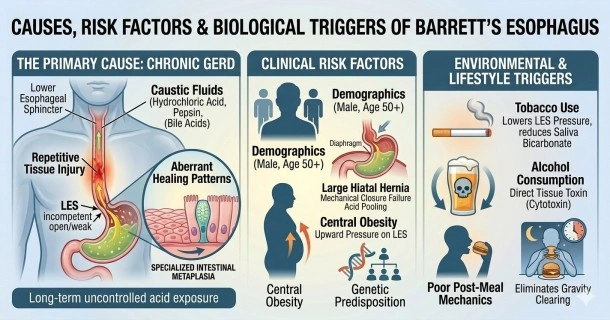
Explore what causes Barrett's esophagus, including the roles of chronic acid reflux, hiatal hernias, metabolic factors, and genetic risks in triggering tissue changes.
Barrett's Esophagus Causes, Clinical Risk Factors, and Biological Triggers
Barrett’s esophagus is a pathological condition characterized by the replacement of the normal squamous epithelium of the distal esophagus with specialized columnar epithelium. While the precise molecular pathways driving this transformation are still being actively researched, the medical consensus establishes that Barrett's esophagus causes are rooted in chronic, repetitive tissue injury and aberrant healing patterns at the gastroesophageal junction.
Understanding the specific underlying mechanisms and clinical identifiers is essential for screening high-risk individuals before advanced cellular changes occur.
The Primary Cause: Chronic Acid Exposure (GERD)
The single most significant causative factor behind Barrett's esophagus is long-standing, severe Gastroesophageal Reflux Disease (GERD).
When the lower esophageal sphincter (LES)—the muscular valve responsible for sealing off the stomach—fails to maintain sufficient resting pressure or relaxes inappropriately, it permits highly caustic gastric contents to escape upward. The fluid that washes back into the lower food pipe is not just simple stomach acid (hydrochloric acid); it is a highly toxic biochemical cocktail containing:
- Pepsin: A powerful digestive enzyme that breaks down proteins and actively digests mucosal tissue cells.
- Bile Acids: Alkaline digestive fluids from the small intestine that, when combined with stomach acid, create a profoundly corrosive mixture that disrupts the cellular integrity of the esophageal lining.
Under constant chemical assault from this refluxate, the normal squamous cells become chronically inflamed and ulcerated. To survive this harsh, low-pH environment, the stem cells at the base of the lining undergo a genetic adaptive shift during the tissue repair phase. They begin generating columnar cells that closely resemble the acid-resistant lining of the intestines (specialized intestinal metaplasia).
Clinical Risk Factors
While chronic GERD provides the physiological framework for tissue injury, only about 10% to 15% of individuals with long-term reflux go on to develop this cellular transformation. Clinical data reveals several distinct risk factors for intestinal metaplasia that heavily influence which individuals are susceptible:
- Duration and Frequency of Reflux: Individuals who have suffered from severe, uncontrolled acid reflux symptoms for longer than 5 to 10 years experience exponentially higher rates of cellular shifts.
- Demographics (Age and Gender): The condition is diagnosed significantly more often in males than in females, and it occurs most frequently in adults aged 50 and older.
- Anatomical Anomalies (Hiatal Hernia): A large hiatal hernia occurs when the upper portion of the stomach slips upward through the diaphragm into the chest cavity. This physical displacement compromises the mechanical closure of the LES, ensuring continuous, heavy acid pooling directly against the lower esophageal lining.
- Central Obesity: Metabolic and physical factors associated with elevated visceral fat put continuous upward physical pressure on the stomach cavity, physically forcing gastric juices past the lower esophageal valve.
- Genetic Predisposition: A family history of Barrett's esophagus or esophageal adenocarcinoma significantly elevates an individual's personal baseline risk, suggesting inherited genetic variations in tissue vulnerability.
Environmental and Lifestyle Triggers
While specific daily habits do not directly rewrite a cell's DNA to cause metaplasia on their own, certain external factors act as potent triggers for Barrett's esophagus by actively accelerating tissue damage and crippling the body's natural clearing defenses:
- Tobacco Use: Nicotine is a potent chemical relaxant that lowers the pressure of the LES while simultaneously reducing the production of saliva. Because saliva contains natural bicarbonate that neutralizes trace acid in the food pipe, smoking strips away the esophagus's primary chemical shield.
- Alcohol Consumption: Alcohol acts as a direct tissue toxin (cytotoxin) that compromises the mucosal barrier, making the lining far more vulnerable to burning when acid reflux occurs.
- Poor Post-Meal Mechanics: Regularly eating heavy, high-fat meals right before sleeping or lying flat eliminates the clearing benefit of gravity, leading to prolonged nighttime acid exposure.
Frequently Asked Questions (FAQs)
Can you develop Barrett's esophagus without having GERD?
Yes. While chronic GERD is the primary risk factor, a notable subgroup of patients are diagnosed with Barrett's esophagus despite never experiencing classic heartburn symptoms. This is often due to "silent reflux," where acid travels up the food pipe without causing painful nerve sensations, or because their tissue is naturally less sensitive to chemical irritation.
Why is Barrett's esophagus more common in men than in women?
The exact biological reason remains under clinical study, but researchers attribute the higher prevalence in men to differences in fat distribution. Men are anatomically more prone to accumulating visceral fat around the central abdominal organs (central obesity), which exerts continuous upward pressure on the stomach, forcing acid into the esophagus.
Does a hiatal hernia directly cause Barrett's esophagus?
A hiatal hernia does not directly alter esophageal cells, but it is a major contributing cause. By shifting a portion of the stomach above the diaphragm, it physically disables the lower esophageal sphincter (LES). This mechanical failure allows stomach acid to flow upward freely and continuously pool against the esophageal lining, triggering the cellular transformation over time.