
Explore advanced treatment options for Eosinophilic Esophagitis (EoE). Learn about the 6-Food Elimination Diet, topical steroids, biologics, and dilation safety.
Eosinophilic Esophagitis Treatment Guidelines
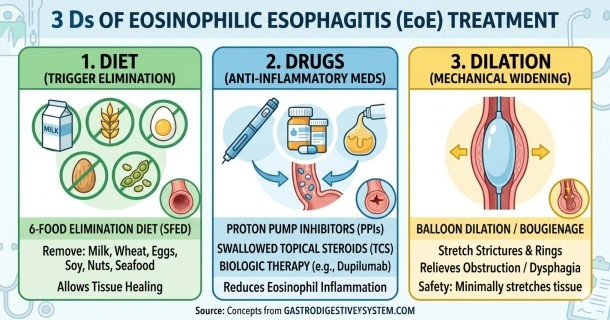
Eosinophilic Esophagitis (EoE) treatment relies on the clinical strategy of the "3 Ds"—Diet, Drugs, and Dilation—to achieve rapid symptomatic relief and long-term tissue remission. The core objective of therapy is to resolve dysphagia (swallowing difficulties), clear inflammatory eosinophil accumulation from the tissue wall, and prevent permanent structural scarring.
1. Dietary Management Protocols
Because EoE is an allergen-driven condition, eliminating problematic food proteins can heal the esophageal lining directly.
- Six-Food Elimination Diet (SFED): Instead of relying on inconsistent skin prick or patch tests, clinicians frequently recommend the SFED empirical trial. This requires completely removing the six most common food allergens: cow’s milk (casein/whey), wheat, eggs, soy, peanuts/tree nuts, and seafood. After achieving tissue remission, foods are systematically reintroduced one by one alongside follow-up biopsies to pinpoint the exact trigger.
- Elemental Diet: A highly restrictive option where all solid foods are replaced with an allergen-free, amino-acid-based liquid formula. While highly effective at eliminating inflammation, it is typically reserved for severe pediatric cases due to taste and adherence challenges.
2. Advanced Pharmacological Treatments
When dietary restrictions are not feasible or fail to achieve complete histological healing, targeted medications are deployed to block the hyperactive immune cascade. [1]
- Proton Pump Inhibitors (PPIs): Medications such as omeprazole, pantoprazole, and esomeprazole serve as standard first-line therapies. In addition to reducing stomach acid production to prevent acid reflux from aggravating the inflamed food pipe, PPIs possess independent anti-inflammatory properties that repair the esophageal barrier.
- Swallowed Topical Corticosteroids (TCS): Medications like fluticasone propionate or specialized viscous oral suspensions (budesonide) are designed to be swallowed rather than inhaled into the lungs. The medication coats the inner lining of the esophagus to target localized inflammation directly. To optimize tissue contact, patients must avoid eating or drinking for two hours after administration.
- Targeted Biologic Therapies: Advanced options like dupilumab (Dupixent) are FDA-approved as weekly home self-injections for adults and children as young as 1 year old. This monoclonal antibody blocks the interleukin-4 (IL-4) and interleukin-13 (IL-13) pathways responsible for recruiting eosinophils to the esophagus, providing an important option for patients who do not respond to traditional anti-inflammatory medications.
3. Mechanical Esophageal Dilation
If medical and dietary approaches do not fully clear a severe physical obstruction, mechanical therapy is utilized to widen the path for food.
- The Dilation Procedure: Performed safely during an outpatient endoscopy, a specialist positions an empty balloon or a specialized tube across the narrowed region. The balloon is carefully inflated to stretch or micro-fracture tough fibrostenotic tissue strictures.
- Safety & Maintenance Rules: To avoid deep mucosal tears or rare esophageal wall perforations, doctors utilize minimal force during structural adjustments. Because dilation strictly addresses mechanical narrowing but does not cure the underlying chronic allergic inflammation, patients must continue their anti-inflammatory diets or medications concurrently to prevent the strictures from returning.
Frequently Asked Questions (FAQ)
What are the side effects of swallowed topical steroids?
Because swallowed topical steroids act locally on the esophageal tissue and are minimally absorbed into the bloodstream, standard systemic steroid side effects are highly rare. The most common localized side effect is a mild fungal infection of the mouth or throat known as oral thrush (Candida). This can easily be treated with antifungal rinses.
Can Eosinophilic Esophagitis be completely cured?
There is currently no permanent cure for EoE, meaning it is a chronic lifelong condition that cannot be outgrown. However, symptoms and tissue inflammation can be completely controlled and managed long-term through consistent dietary adjustments and maintenance medication regimens.
How long does it take for an elimination diet to show results?
Most patients experience a noticeable improvement in swallowing difficulty within a few weeks of beginning the Six-Food Elimination Diet. However, doctors typically wait 8 to 12 weeks before performing a follow-up endoscopy and biopsy to microscopically confirm that the tissue inflammation has resolved.