
Explore how doctors treat pyloric stenosis. Learn about the surgical gold standard, the Ramstedt pyloromyotomy, and the stabilization process using IV fluids.
Pyloric Stenosis Treatment: Stabilization and Surgery
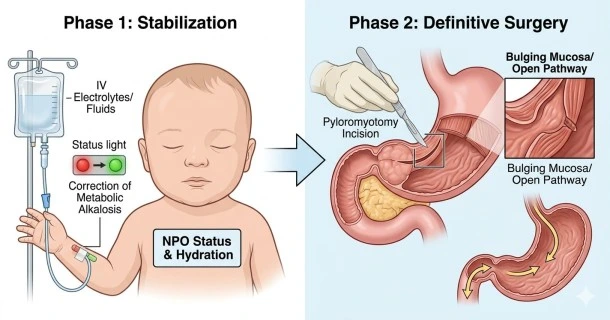
Definitive treatment for pyloric stenosis is entirely mechanical, as the underlying condition is caused by a physical muscle blockage at the stomach outlet. While surgery provides a fast, permanent cure, the therapeutic process is carefully divided into two critical phases: immediate metabolic stabilization and surgical correction.
Phase 1: Preoperative Stabilization (The True Priority)
Pyloric stenosis is never a surgical emergency, but it is a medical stabilization priority. Before an infant can safely receive general anesthesia, doctors must completely reverse the metabolic damage caused by severe, recurrent projectile vomiting.
- Nil by Mouth (NPO Status): Oral feeds are immediately suspended to prevent further vomiting and eliminate the risk of aspiration into the lungs. A nasogastric (NG) tube may be inserted to drain remaining stomach acids and keep the stomach empty.
- Intravenous (IV) Resuscitation: Patients are started on continuous intravenous fluids, typically using a combination of normal saline and dextrose.
- Electrolyte and Acid-Base Correction: The medical team closely monitors blood panels. Potassium is added to the IV line once adequate urine output is established. Surgery is only cleared once the blood pH, chloride, and potassium levels return to normal—a process that usually takes 24 to 48 hours.
Phase 2: Definitive Surgical Correction
Once the patient is metabolically stable, a pediatric surgeon performs the definitive procedure to permanently clear the blockage.
The Pyloromyotomy (Ramstedt Procedure)
The gold standard surgical treatment for infant hypertrophic pyloric stenosis is a pyloromyotomy.
- The Technique: Under general anesthesia, the surgeon makes a precise incision through the outer, thickened layers of the enlarged pyloric sphincter muscle.
- Relieving the Pressure: The surgeon carefully cuts and separates the rigid muscle fibers until the flexible, healthy inner lining (mucosa) bulges out through the gap. The inner lining is left entirely intact. This division completely releases the compression, immediately opening a wide channel for food to pass into the intestines.
- Surgical Options: This can be performed via a traditional open approach (a tiny incision near the navel) or a minimally invasive laparoscopic approach, which uses scopes and offers faster healing times.
Adult Pyloric Stenosis Treatment
Because adult cases are caused by rigid, fibrotic scar tissue from chronic ulcers rather than simple infant muscle overgrowth, treatment plans are adjusted:
- Endoscopic Balloon Dilation: A doctor threads a specialized scope down the esophagus and uses a wire-guided balloon to mechanically inflate and stretch open the scarred pylorus.
- Surgical Pyloroplasty: If dilation fails due to dense scarring, a surgeon will perform a pyloroplasty (such as a Finney or Jaboulay procedure). This technique cuts across the scarred region and reshapes the gastric outlet to bypass the obstruction entirely.
Postoperative Recovery and Feeding Timeline
Recovery after a pyloromyotomy is typically rapid and highly successful:
- Resuming Feeds: Micro-feedings of breast milk or formula usually begin within 4 to 12 hours after anesthesia wears off. The volume is slowly stepped up over the day.
- Post-Op Spitting: It is perfectly normal for a baby to experience mild spitting up for the first 24 to 48 hours as the irritated stomach tissue heals.
- Hospital Discharge: Most infants tolerate full feeds quickly and are safely discharged home within 1 to 3 days post-surgery.
Frequently Asked Questions (FAQs)
Is a pyloromyotomy surgery dangerous for a young baby?
While any surgery carries standard procedural risks, a pyloromyotomy is considered a routine, highly perfected pediatric operation with an exceptionally high success rate and minimal complications. The risk of the condition returning after the procedure is practically zero.
Can pyloric stenosis be cured with medications instead of surgery?
In extremely rare scenarios where a baby has severe underlying medical conditions that make general anesthesia too dangerous, doctors may attempt medical management using atropine sulfate. However, this method requires a significantly longer hospital stay, has a lower overall success rate, and is rarely chosen over surgery.
Why must surgery be delayed if the baby is projectile vomiting?
Rushing into the operating room while a baby is severely dehydrated is dangerous. An imbalance in blood chemistry (metabolic alkalosis) elevates the risk of severe respiratory complications and breathing pauses under anesthesia. Spending 24 to 48 hours on IV fluids ensures the infant's body is fully stable and safe for the procedure.
What is the long-term outlook for a child after pyloric stenosis surgery?
The long-term outlook is excellent. Once the pyloric muscle is split, the stomach functions normally. Children recover quickly, experience healthy catch-up weight gain, and do not suffer from any long-term digestive issues or developmental side effects later in life.