
An essential introduction to Crohn's disease. Learn about this chronic inflammatory bowel disease (IBD), its anatomical types, and how it impacts the digestive tract.
What is Crohn’s Disease? An Introduction to Chronic Intestinal Inflammation
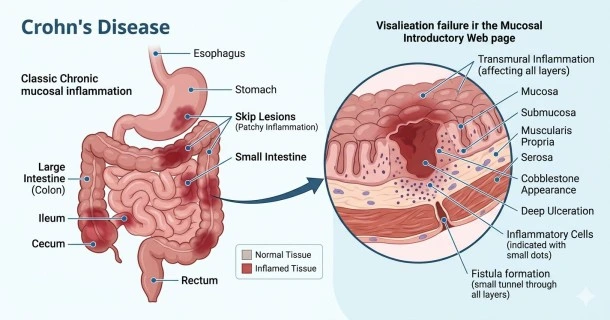
Crohn’s disease is a chronic, progressive inflammatory bowel disease (IBD) characterized by transmural inflammation that can affect any segment of the gastrointestinal tract from the mouth to the anus. Named after Dr. Burrill B. Crohn, who first described the condition in 1932, it most frequently develops in the terminal ileum (the furthest part of the small intestine) and the colon. Unlike other superficial gastrointestinal issues, the inflammation associated with Crohn's disease penetrates deep into the lining of the affected digestive tissues, leading to structural modifications over time.
Because Crohn’s disease is a systemic, immune-mediated condition, its clinical manifestations extend beyond basic digestive discomfort, frequently involving extraintestinal complications in the joints, skin, eyes, and liver.
Crohn’s Disease vs. Ulcerative Colitis: Key Differences
Patients and web users frequently conflate the two primary forms of Inflammatory Bowel Disease (IBD). They are clinically distinct:
| Feature | Crohn's Disease | Ulcerative Colitis |
|---|---|---|
| Location | Anywhere from mouth to anus (patchy "skip lesions"). | Limited strictly to the colon and rectum (continuous inflammation). |
| Depth of Inflammation | Transmural (affects all tissue layers). | Mucosal (limited to the innermost lining). |
| Granulomas | Frequently present upon biopsy. | Absent. |
Anatomical Types of Crohn’s Disease
Crohn's disease is classified into distinct phenotypes based entirely on the specific region of the gastrointestinal tract where the inflammation occurs.
- Ileocolitis: The most common form, affecting both the terminal ileum (small intestine) and the large intestine (colon).
- Ileitis: Inflammation isolated exclusively to the ileum.
- Gastroduodenal Crohn's Disease: Affects the stomach and the duodenum (the beginning of the small intestine).
- Jejunoileitis: Causes patchy areas of inflammation in the jejunum (the upper half of the small intestine).
- Crohn’s (Granulomatous) Colitis: Inflammation restricted purely to the colon, leaving the small intestine unaffected.
Pathophysiology: What Happens inside the Digestive Tract?
The core mechanism of Crohn’s disease involves an inappropriate, overactive immune response. The body’s immune system mistakenly targets harmless environmental antigens, dietary components, or symbiotic gut bacteria inside the intestinal lumen.
This sustained immune assault triggers a massive influx of inflammatory cells into the bowel wall. Over time, this chronic transmural swelling leads to architectural changes in the tissue, including:
- Cobblestone Appearance: Deep ulcerations separated by islands of normal, edematous mucosa.
- Fibrosis and Strictures: The repeated cycle of injury and healing deposits scar tissue, narrowing the intestinal lumen.
- Fistulas: Abnormal tunnels or tracts connecting the inflamed bowel to other loops of intestine, bladder, skin, or adjacent organs.
Frequently Asked Questions (FAQs)
Can Crohn’s disease be permanently cured?
No, there is currently no permanent medical cure for Crohn's disease, but it can be managed effectively into long-term clinical remission. Treatment strategies rely on customized therapeutic steps—including biologic therapies, immunomodulators, corticosteroids, and targeted dietary interventions—to quiet the overactive immune response and allow the intestinal mucosa to heal.
Is Crohn’s disease considered an autoimmune disorder?
While it behaves similarly, Crohn's disease is strictly classified as an immune-mediated inflammatory disease rather than a classic autoimmune disorder. In autoimmune diseases, the immune system directly attacks the body's own healthy tissue cells. In Crohn’s disease, the damage is caused by a dysregulated, hyper-aggressive immune response directed against foreign microbes and matter inside the gut lumen.
Does having Crohn’s disease mean I will definitely need surgery?
Not necessarily, though a significant percentage of individuals with Crohn's disease may require surgical intervention at some point in their lives. Surgery is not curative but is utilized strategically to manage complex complications that do not respond to medications, such as clearing bowel obstructions, closing complex fistulas, or removing severely scarred intestinal segments (strictures).