
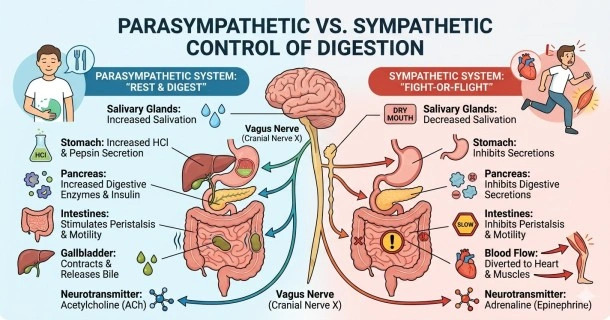
Explore how the parasympathetic nervous system regulates digestion. Learn about the vagus nerve, acetylcholine, and the rest-and-digest response.
Parasympathetic Nerves: How the Nervous System Controls Digestion
The human digestive system is automatically regulated by the Autonomic Nervous System (ANS), which manages vital bodily processes without our conscious effort. The ANS operates via two primary pathways that act like an accelerator and a brake pedal for gut function: the Sympathetic Nervous System (SNS) and the Parasympathetic Nervous System (PNS).
While the sympathetic branch prepares the body for stress, the parasympathetic nervous system is the primary driver of "rest and digest" activities, ensuring smooth digestion, nutrient absorption, and metabolic balance.
The Autonomic Balance: Sympathetic vs. Parasympathetic Control
To understand how the gut operates, it is essential to look at how these two opposing branches of the autonomic nervous system interact:
The Sympathetic Nervous System (SNS)
- Role: Governs the fight-or-flight response during times of stress, fear, or anger.
- Impact on Gut: To prioritize immediate survival, the SNS diverts blood flow away from the gastrointestinal (GI) tract toward the heart, lungs, and skeletal muscles. This effectively inhibits, slows, or completely stops digestion.
The Parasympathetic Nervous System (PNS)
- Role: Directs the body's recovery, conservation of energy, and rest-and-digest functions.
- Impact on Gut: The PNS optimizes digestion by increasing blood flow to the GI tract, accelerating motility, and triggering the release of essential digestive fluids.
Key Functions of the Parasympathetic Nervous System in Digestion
When the parasympathetic nervous system is highly active, it orchestrates a series of coordinated events across the digestive tract:
- Stimulates Salivation: Triggers the salivary glands to produce saliva, which initiates the chemical breakdown of carbohydrates.
- Promotes Peristalsis: Enhances the rhythmic, wave-like muscular contractions of the stomach and intestines to move food forward.
- Drives Gastric Secretions: Commands the stomach lining to secrete hydrochloric acid (HCl) and digestive enzymes.
- Triggers Bile Release: Signals the liver and gallbladder to release bile acids to facilitate fat emulsification and absorption.
- Modulates Metabolic Output: Stimulates insulin secretion from the pancreas to regulate blood glucose levels as nutrients enter the bloodstream.
The Vagus Nerve: The Highway of Gut-Brain Communication
The primary pathway of the parasympathetic nervous system is the vagus nerve (the tenth cranial nerve). Originating in the brainstem's medulla oblongata, the vagus nerve extends downward through the neck and thorax into the abdomen, sending out intricate branches to the heart, lungs, stomach, and intestines.
The vagus nerve operates as a bidirectional communication highway:
- Afferent Signals (Body-to-Brain): It collects sensory data regarding nutrient saturation and gut distension, sending it up to the brain.
- Efferent Signals (Brain-to-Body): It transmits regulatory commands downward to control smooth muscle movements and continuous enzyme production.
Dual Control: Extrinsic vs. Intrinsic Gut Nerves
Gastrointestinal function relies on a sophisticated interplay between nerves originating outside the gut and those entirely contained within it:
1. Extrinsic Nerves (The Outside Regulators)
These nerves travel directly from the brain or spinal cord to the digestive organs, utilizing two main neurotransmitters to alter function:
- Acetylcholine (ACh): The primary neurotransmitter of the PNS. It binds to receptors to increase the force of GI muscular contractions, accelerate food transit, and stimulate juice production in the stomach and pancreas.
- Adrenaline (Epinephrine): The primary hormone/neurotransmitter of the SNS. It counteracts acetylcholine by relaxing gut muscles and constricting blood vessels, which halts active digestion.
2. Intrinsic Nerves (The Enteric Nervous System)
Often referred to as the "second brain," the Enteric Nervous System (ENS) consists of an expansive network of neurons embedded directly within the tissue walls of the esophagus, stomach, small intestine, and colon.
- Trigger: The ENS is locally activated when food enters an organ and stretches its walls.
- Action: It autonomously coordinates localized muscle contractions and triggers regional juice secretions to manage digestion in real-time.
Frequently Asked Questions (FAQ)
How does the parasympathetic nervous system affect digestion?
The parasympathetic nervous system stimulates digestion by accelerating intestinal motility (peristalsis), increasing blood flow to the gastrointestinal tract, and triggering the secretion of saliva, stomach acid, bile, and pancreatic enzymes.
What is the role of the vagus nerve in digestion?
The vagus nerve (cranial nerve X) serves as the primary neural pathway for the parasympathetic nervous system. It acts as a bidirectional communication line, sending signals from the brain to control gut muscle contractions and acid production, while carrying sensory data about nutrient levels back to the brain.
What is the difference between extrinsic and intrinsic gut nerves?
Extrinsic nerves originate outside the digestive tract (in the brain or spinal cord) and use neurotransmitters like acetylcholine and adrenaline to broadly speed up or slow down gut function. Intrinsic nerves make up the Enteric Nervous System, which is embedded inside the gut walls and controls localized movement and enzyme release automatically when stretched by food.
Why does stress stop the digestive process?
During stress, the Sympathetic Nervous System activates the fight-or-flight response. It releases adrenaline, which relaxes the digestive muscles and constricts local blood vessels to divert blood flow to the heart and muscles, causing digestion to slow down or stop completely.