
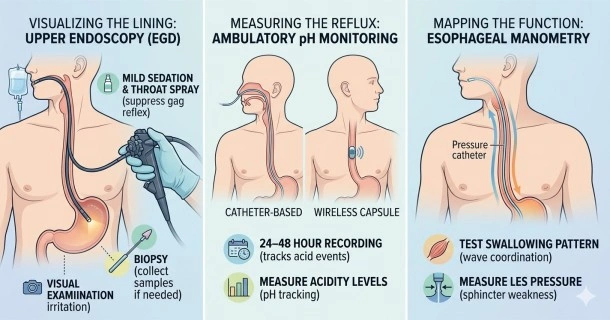
Learn how doctors diagnose Gastroesophageal Reflux Disease (GERD). Explore diagnostic tools including upper endoscopy, pH monitoring, and esophageal manometry.
How Is Gastroesophageal Reflux Disease (GERD) Diagnosed?
For many individuals experiencing standard acid reflux, a clinical diagnosis can be made based entirely on a physical exam and a review of your regular symptoms. If your heartburn is mild, predictable, and resolves with basic lifestyle adjustments, formal diagnostic testing may not be immediately necessary.
However, if your symptoms are severe, long-lasting, fail to respond to over-the-counter medications, or include warning signs like unintended weight loss or difficulty swallowing, specialized diagnostic evaluation is crucial to confirm GERD and rule out structural complications.
Common Diagnostic Tests for GERD
When a gastroenterologist needs to visualize the digestive tract or measure its physical function, they rely on several standard diagnostic procedures.
1. Upper Endoscopy (Esophagogastroduodenoscopy or EGD)
An upper endoscopy allows a physician to directly examine the interior lining of your esophagus, stomach, and the first part of your small intestine.
- What to Expect: Before the procedure, a local anesthetic spray or gargle is applied to the back of your throat to numb the area and suppress your gag reflex, and a mild sedative is typically administered intravenously to help you remain relaxed and comfortable. The doctor then gently guides a thin, flexible, illuminated tube equipped with a microscopic camera (an endoscope) down your throat.
- Biopsy Selection: If the doctor observes areas of inflammation, tissue irritation, or suspected abnormal growths, they can pass tiny forceps through the endoscope to collect a minute tissue sample (biopsy) for laboratory analysis. This helps evaluate for conditions like Esophagitis, Helicobacter pylori infections, or cellular changes.
2. Ambulatory Acid (pH) Monitoring
This test serves as the gold standard for measuring precisely when and how much stomach acid is escaping back upward into your esophagus over a set period (usually 24 to 48 hours).
- What to Expect: There are two common methods. The traditional method utilizes a thin, flexible catheter inserted through the nose and anchored into the esophagus. A newer, wireless alternative involves temporarily clipping a tiny, capsule-shaped sensor directly to the esophageal wall during an endoscopy.
- Clinical Utility: As you go about your normal daily routines, eating and sleeping, the device continuously records pH levels. This test is highly useful for mapping out whether atypical respiratory symptoms—such as an unexplained chronic cough or nighttime wheezing—are directly triggered by acid reflux events.
3. Esophageal Manometry
This specialized functional study measures the rhythmic muscle contractions, coordination, and physical force exerted by your esophagus when you swallow food or liquids.
- What to Expect: A thin, pressure-sensitive catheter is passed through the nose and positioned carefully inside the esophagus. You will be asked to take small sips of water while sensors record the exact wave-like movements of your esophageal muscles and the resting pressure of your lower esophageal sphincter (LES).
- Clinical Utility: This test helps confirm if a weak or poorly coordinated LES muscle is driving your reflux, and it effectively rules out alternative esophageal motility disorders.
4. Barium Swallow Radiograph (Upper GI Series)
This structural imaging study uses standard X-rays to map out the physical anatomy of your upper digestive tract.
- What to Expect: You will be asked to drink a thick, chalky liquid solution containing barium. As the liquid flows downward, it temporarily coats the inner lining of your upper digestive system, allowing it to stand out clearly on an X-ray screen.
- Clinical Utility: A barium swallow is highly effective at identifying anatomical abnormalities, such as structural narrowings (strictures), open sores (ulcers), or a hiatal hernia pushing through the diaphragm muscle.
Who Requires Advanced GERD Testing?
Specialized diagnostic workups are typically reserved for patients who fall into specific clinical categories:
- Refractory Symptoms: Individuals whose chronic heartburn or regurgitation shows no objective improvement after standard courses of acid-suppression therapy.
- Alarm Symptoms: Anyone experiencing warning flags like progressive difficulty swallowing (dysphagia), painful swallowing (odynophagia), unexpected weight loss, or signs of gastrointestinal bleeding.
- Long-Term Monitoring: Individuals who have lived with severe, unmanaged GERD symptoms for more than five years may be monitored closely to check for Barrett’s esophagus—a condition where chronic acid exposure alters the cellular lining of the esophagus, requiring periodic endoscopic surveillance to detect early signs of pre-cancerous shifts.
Frequently Asked Questions (FAQs)
Is an upper endoscopy painful?
An upper endoscopy is generally not painful. The combination of a topical numbing spray applied directly to the throat and a mild intravenous sedative ensures that most patients feel relaxed, experience minimal throat discomfort, and often have little to no memory of the short procedure afterward.
Why do I need a 24-hour pH test if I already had an endoscopy?
An upper endoscopy provides a visual, structural snapshot of your tissue lining, showing if physical damage or inflammation is present. A 24-hour pH test measures the actual behavioral function of your reflux over time, proving a direct mathematical link between your specific symptoms (like a coughing fit) and individual acid backup events.
Can a regular chest X-ray diagnose GERD?
No. A standard chest X-ray is designed to visualize your bones, lungs, and heart structures, but it cannot clearly show the soft tissue lining of your esophagus or trace the movement of liquid acid. To evaluate your digestive anatomy via X-ray, a specialized barium swallow test must be performed instead.