
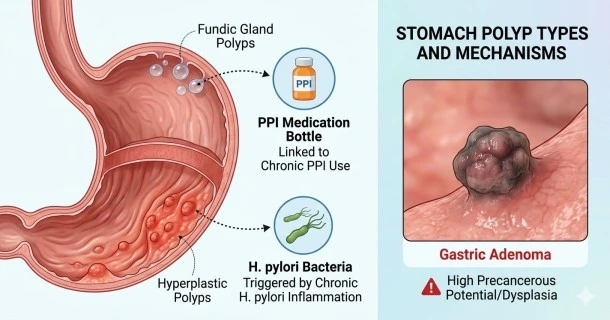
Learn about stomach polyps (gastric polyps). Discover the differences between fundic gland, hyperplastic, and adenomatous polyps, and when they require removal.
What Are Stomach Polyps?
Stomach polyps—also medically referred to as gastric polyps—are abnormal masses or clumps of cells that form on the inner mucosal lining of the stomach wall.
For most individuals, stomach polyps are an incidental finding. They are usually discovered unexpectedly by a gastroenterologist during a routine upper endoscopy procedure performed to investigate an entirely unrelated digestive issue. While the vast majority of gastric polyps are benign (non-cancerous) and do not cause noticeable complications, certain specific cellular variations can serve as precursors to stomach cancer.
The Three Primary Types of Gastric Polyps
Gastric polyps are categorized into distinct types based on their cellular composition and what triggered their initial growth:
1. Fundic Gland Polyps
This is statistically the most common type of stomach polyp found in Western populations. They grow from the acid-producing glandular cells in the upper part (fundus) of the stomach.
- The Link to PPIs: Fundic gland polyps frequently develop in individuals who are on long-term, chronic therapy with Proton Pump Inhibitors (PPIs)—common acid-reducing medications like omeprazole or pantoprazole.
- Cancer Risk: In sporadic cases, the risk of malignancy is virtually non-existent unless they grow larger than 1 centimeter. However, they can occur in large numbers in individuals with an inherited genetic syndrome known as Familial Adenomatous Polyposis (FAP), where the risk of cancer is elevated.
2. Hyperplastic Polyps
Hyperplastic polyps typically arise as a direct tissue response to chronic, long-standing cellular inflammation or irritation of the stomach lining (chronic gastritis).
- The Link to H. pylori: They are highly correlated with an active Helicobacter pylori (H. pylori) bacterial infection or autoimmune gastritis.
- Cancer Risk: While generally safe, hyperplastic polyps that grow larger than 2 centimeters carry a higher statistical risk of containing focal areas of dysplasia (precancerous changes) and may require endoscopic removal.
3. Gastric Adenomas (Adenomatous Polyps)
Adenomas are the least common type of stomach polyp, but they are the most clinically significant.
- The Precancerous Threat: Adenomas develop from altered epithelial cells and are widely considered directly precancerous.
- Management: Because they have a strong tendency to progress into malignant stomach cancer over time, all detected gastric adenomas must be completely removed surgically or endoscopically, followed by routine surveillance.
Navigate Our Comprehensive Gastric Polyp Guides
To help you understand your diagnosis thoroughly, we have mapped out detailed, dedicated sub-resources tailored to fulfill your specific questions:
- Recognize Potential Symptoms: Learn how large polyps can occasionally cause occult bleeding, unexplained chronic anemia, or physical blockages.
- Explore Root Causes: Read about the cellular mechanisms behind H. pylori colonization, mucosal inflammation, and medication triggers.
- Identify Key Risk Factors: Find out how aging, genetic syndromes (like FAP), and daily habits impact your susceptibility.
- Understand Dietary & Environmental Triggers: Review external lifestyle factors and medication timelines that may spark mucosal tissue overgrowth.
- Diagnosis & Biopsy Procedures: Discover what happens during an upper endoscopy and how histopathological tissue biopsies rule out cancer.
- Treatment & Removal Options: Read about endoscopic polypectomy procedures, antibiotic eradication therapies, and follow-up care.
Frequently Asked Questions (FAQs)
Can stomach polyps turn into cancer?
Yes, certain types can, though the majority do not. Gastric adenomas are inherently precancerous and carry a high risk of transforming into malignancy. Hyperplastic polyps and fundic gland polyps are mostly benign, but their risk of developing abnormal cells increases significantly if they grow unusually large (typically over 1 to 2 centimeters).
Do proton pump inhibitors (PPIs) cause stomach polyps?
Long-term, uninterrupted use of proton pump inhibitors (PPIs) for acid reflux or GERD is heavily linked to the development of fundic gland polyps. The medication causes the parietal cells in the stomach lining to alter their structure, resulting in small, benign glandular cysts. If PPI-induced polyps grow large, a doctor may recommend tapering off the medication.
Can an H. pylori infection make stomach polyps grow?
Yes. An H. pylori bacterial infection triggers chronic mucosal inflammation, which leads to the formation of hyperplastic stomach polyps. Interestingly, if the underlying H. pylori infection is successfully eradicated using a targeted course of antibiotics, these hyperplastic polyps will often shrink or completely disappear on their own without requiring surgery.
How are stomach polyps removed?
Most stomach polyps are removed during an upper endoscopy (endoscopic polypectomy). The gastroenterologist passes specialized wire snares or electrical cautery tools through the endoscope tube to cleanly snip and seal the polyp at its base. The procedure is minimally invasive, usually painless, and allows the tissue to be sent directly to a pathology lab for evaluation.