
Explore how doctors test for gastroparesis. Learn about the 4-hour gastric emptying scintigraphy gold standard, breath tests, and wireless capsules.
Gastroparesis Diagnosis: Gastric Emptying Tests and Clinical Procedures
Diagnosing gastroparesis requires a structured clinical approach that first rules out mechanical obstructions—such as physical blockages from tumor masses or deep ulcer scar tissue—and drug-induced motility delays. Because the symptoms of delayed gastric emptying (like nausea, bloating, and early satiety) heavily overlap with other functional gastrointestinal disorders, objective diagnostic testing is essential to confirm a true neuromuscular stomach impairment.
To establish a definitive diagnosis, gastroenterologists utilize specialized nuclear imaging, breath analysis, and advanced wireless tracking technology.
1. The Diagnostic Gold Standard: Gastric Emptying Scintigraphy
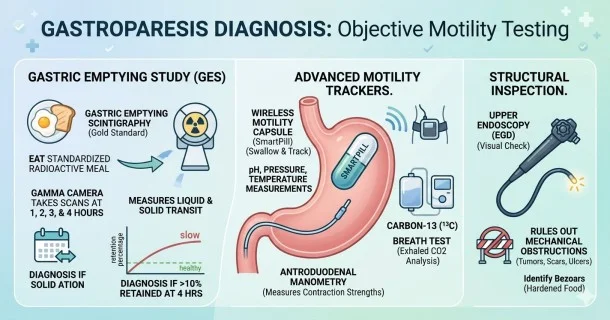
Solid-phase Gastric Emptying Scintigraphy (GES) is universally recognized by the medical community as the gold standard for confirming gastroparesis.
- The Procedure: You will consume a standardized low-fat meal (typically an egg-white meal or an egg-substitute equivalent) that has been labeled with a tiny, safe amount of a radioactive isotope called Technetium-99m (99mTc).
- The Scan Timeline: An external gamma camera captures images of your abdomen at specific intervals—typically at 1, 2, 3, and 4 hours after ingestion—to track how quickly the radioactive food leaves your stomach cavity.
- The Diagnostic Threshold: A diagnosis of gastroparesis is officially confirmed if a patient displays greater than 10% gastric retention of solids at the 4-hour mark. (Note: Relying on shorter 1-hour or 2-hour windows drastically reduces the test's diagnostic sensitivity).
- Medication Restrictions: To guarantee accurate results, patients must completely stop taking narcotic pain relievers, prokinetic motility drugs, and GLP-1 receptor agonists for 5 to 7 days prior to the test, as these medications heavily interfere with natural stomach emptying rates.
2. Advanced and Emerging Motility Modalities
When standard nuclear scintigraphy is unavailable or if a comprehensive evaluation of the entire digestive tract is required, specialists utilize alternative diagnostic technologies:
- Wireless Motility Capsule (SmartPill): You swallow a small, single-use electronic capsule alongside a standardized meal. As the capsule travels naturally through your digestive system, it continuously measures localized pH, pressure, and temperature changes, broadcasting the data telemetrically to a recorder worn on your waist. A sudden, sharp rise in pH signifies that the pill has successfully exited the highly acidic stomach and entered the alkaline duodenum, providing an exact measure of gastric transit time.
- Carbon-13 (13C) Gastric Emptying Breath Test: A non-radioactive alternative where a safe, stable carbon isotope is mixed into a solid meal. Once the food empties into the small intestine, it is rapidly absorbed and metabolized by the liver into carbon dioxide (13CO2), which is then exhaled through the lungs. By measuring the concentration of tagged carbon in your breath at regular intervals, doctors can precisely calculate your solid-phase stomach emptying speed.
3. Structural Evaluation and Specialized Manometry
These procedures are utilized to rule out physical obstructions or to investigate the specific nerve and muscle layers driving a severe motility failure:
- Upper Endoscopy (EGD): A flexible tube equipped with a camera is passed down your esophagus to visually inspect your stomach lining. While an endoscopy cannot measure transit speed, it is mandatory to rule out mechanical blocks or look for retained food or a hardened mass (bezoar) after an overnight fast, which strongly suggests gastroparesis.
- Antroduodenal Manometry: A specialized procedure where a pressure-sensing catheter is passed through the pyloric channel. By recording muscle contractions over a 5 to 8-hour period during fasting and eating states, it can differentiate between a muscular disease (myopathy, indicated by low contraction force under 30 mmHg) and a nerve disease (neuropathy, indicated by uncoordinated, chaotic muscle bursts).
- Electrogastrography (EGG): Fixes cutaneous electrodes onto the skin of the abdomen to measure the electrical slow-waves of the stomach wall. A healthy stomach ticks at a steady rate of 3 cycles per minute, and a significant departure from this baseline indicates a severe gastric dysrhythmia.
Frequently Asked Questions (FAQ)
What is the exact percentage threshold used to diagnose gastroparesis during a 4-hour study?
A patient is diagnosed with gastroparesis if their solid-phase gastric emptying study shows greater than 10% of the meal remaining inside the stomach at the 4-hour mark. The original belief that 25% retention is required is medically outdated; modern clinical guidelines from gastroenterology societies explicitly recognize any retention over 10% at 4 hours as a physically delayed clearing state.
Why must weight-loss medications like semaglutide be stopped before a gastric emptying test?
GLP-1 receptor agonists like semaglutide, tirzepatide, and liraglutide slow down stomach clearing as part of their primary pharmacological mechanism to increase feelings of fullness. If you undergo a gastric emptying test while taking these medications, the results will show a significant delay, leading to a false-positive diagnosis of permanent gastroparesis when the delay is actually just a temporary drug side effect.
How does a wireless motility capsule differentiate between your stomach and your small intestine?
The wireless capsule tracks its location by continuously reading the chemical environment surrounding it. The inside of your stomach is incredibly acidic, typically maintaining a very low pH between 1.5 and 3.5. The moment the stomach muscles push the capsule through the pyloric valve into the duodenum, it encounters alkaline pancreatic juices, causing the pH reading to jump sharply above 6.0. This immediate spike marks the exact minute of gastric emptying.