
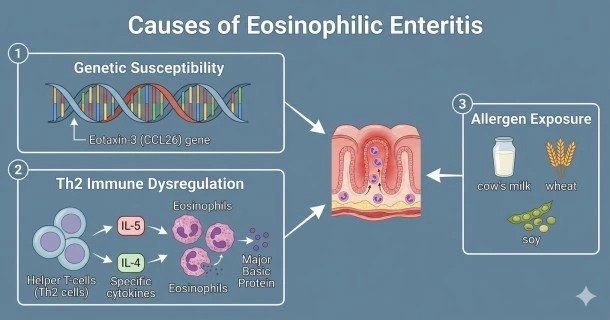
Discover what causes eosinophilic enteritis. Explore the genetic predispositions, immune helper cells (Th2), and environmental allergen interactions behind this rare disease.
Eosinophilic Enteritis Causes: Understanding the Mechanisms Behind Eosinophilic Infiltration
While the precise primary cause of eosinophilic enteritis remains a subject of ongoing clinical investigation, medical research has firmly established that the condition is not random. Instead, eosinophilic enteritis is caused by a complex, multi-factorial interaction between genetic predisposition, an overactive Th2 helper T-cell immune response, and hypersensitivity to specific environmental or dietary allergens.
Understanding these medical mechanisms helps explain why the body mistakenly deploys inflammatory cells to the small intestine and highlights why long-term management focuses heavily on immunological and dietary interventions.
1. Type 2 Helper T-Cell (Th2) Immune Dysregulation
The primary biological driver of eosinophilic enteritis is an overactivation of the body’s Type 2 helper T-cell (Th2) adaptive immune pathway. This specific arm of the immune system is normally tasked with coordinating defenses against parasites and handling allergic responses.
- Cytokine Proliferation: In patients with this disorder, Th2 cells mistakenly perceive normal substances in the gut as active threats. They respond by flooding the system with specific signaling proteins called cytokines, most notably Interleukin-5 (IL-5), Interleukin-4 (IL-4), and Interleukin-13 (IL-13).
- Eosinophil Recruitment: Interleukin-5 acts as a powerful homing signal. It triggers the bone marrow to accelerate the production of eosinophils and chemically guides them directly into the mucosal, muscular, or serosal layers of the small intestine.
- Degranulation and Damage: Once these cells accumulate in the small bowel wall, they undergo degranulation. This process releases highly toxic chemical agents, including eosinophil cationic protein (ECP) and major basic protein (MBP), which tear into healthy intestinal tissue, causing structural inflammation and breakdown.
2. Atopic Tendencies and Allergen Hypersensitivities
A profound link exists between eosinophilic enteritis and systemic allergic diseases (atopy). Clinical data shows that up to 70% of individuals diagnosed with this condition have a personal or immediate family history of allergic disorders.
- Dietary Antigens: For a vast majority of patients, specific dietary proteins act as the direct causal trigger for the Th2 immune cascade. The most common food allergens linked to this process include cow's milk, wheat, soy, eggs, nuts, and seafood.
- Aeroallergens: Emerging environmental research indicates that inhaled allergens, such as pollen, mold spores, and dust mites, can cross-react with or aggravate the immune tissues lining the gastrointestinal tract, causing seasonal fluctuations in disease severity.
3. Genetic Factors and Inherited Risk
Genetics provide the foundational landscape that allows this disease to manifest. While it is rarely passed down as a simple single-gene defect, inherited susceptibilities significantly elevate a person's risk profile.
- The Eotaxin-3 (CCL26) Variant: Variations in genes responsible for encoding eotaxin-3—a specialized chemoattractant protein that binds to eosinophils—have been strongly linked to the development of eosinophilic gastrointestinal disorders. Overexpression of this gene essentially makes the intestinal lining highly attractive to inflammatory white blood cells.
- Family Clustering: Having a first-degree relative with an allergic disease or another eosinophilic disorder (like eosinophilic esophagitis) increases the biological probability of developing the condition.
Frequently Asked Questions (FAQs)
Can eating an unhealthy diet cause eosinophilic enteritis to develop?
No, eating a poor or unhealthy diet does not cause eosinophilic enteritis. The condition is driven by a specific, genetically influenced immune allergy to particular food proteins (like dairy or gluten), not by consuming processed foods or sugars. However, continuing to eat foods containing your specific allergen will continuously drive tissue damage.
Is eosinophilic enteritis caused by a parasitic infection?
No, eosinophilic enteritis is not caused by parasites. In healthy individuals, a parasitic infection will cause blood eosinophil levels to spike temporarily to fight off the organism. In patients with this disease, the immune system mimics this exact parasitic response and floods the small intestine with eosinophils, even though no parasite or active infection is physically present.
Why does the body send eosinophils specifically to the small intestine?
The body directs eosinophils to the small intestine due to an localized overproduction of the homing protein eotaxin-3 within the small bowel's mucosal tissues. This specific regional chemical signal, combined with the dense presence of immune monitoring stations (Peyer's patches) in the small intestine that constantly interact with swallowed food proteins, makes the small bowel a primary target for this allergic immune response.