
Discover what celiac disease is, how it affects the small bowel mucosa, and why gluten triggers this chronic autoimmune condition. Read the clinical overview.
What is Celiac Disease?
Celiac disease is a serious, chronic autoimmune disorder where the ingestion of gluten leads to structural damage in the small intestine. Gluten is a structural protein composite naturally found in grains such as wheat, rye, and barley. Unlike a standard food allergy or a transient food intolerance, celiac disease triggers a systemic, genetically linked immune response that degrades the body's capability to process and absorb essential nutrients.
The Pathophysiology: How Celiac Disease Affects the Bowel
When an individual with celiac disease consumes food containing gluten, their immune system mistakenly identifies the protein as a foreign threat. This triggers an aggressive inflammatory reaction targeted at the lining of the small intestine.
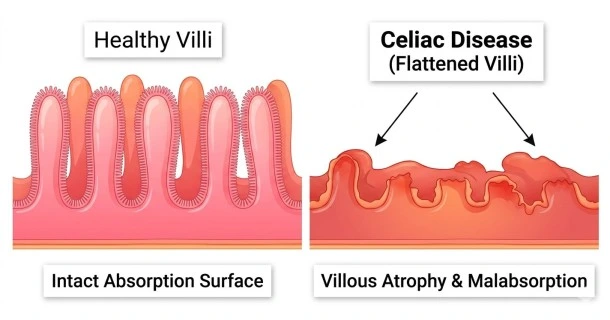
- Destruction of Villi: The inflammation specifically damages the villi—tiny, microscopic, finger-like projections that line the small bowel wall.
- Villous Atrophy: Over time, continuous exposure to gluten causes these villi to flatten and erode, a clinical condition known as villous atrophy.
- Malabsorption Syndrome: Because healthy villi are completely responsible for absorbing vitamins, minerals, fluids, and macronutrients into the bloodstream, their destruction causes severe, systemic nutritional deficiencies.
Key Clinical Facts About Celiac Disease
- Prevalence: Celiac disease is estimated to affect approximately 1% of the global population, though the vast majority of cases remain undiagnosed or misdiagnosed as other functional bowel issues.
- Genetic Link: The condition is highly hereditary. Individuals with a first-degree relative (parent, child, or sibling) who has celiac disease face a 1-in-10 risk of developing it themselves.
- Age of Onset: It can manifest at any stage of life—from early childhood when solids are introduced to later adulthood—following a specific biological trigger.
Celiac Disease vs. Non-Celiac Gluten Sensitivity
It is clinically vital to distinguish celiac disease from other gluten-related conditions:
- Celiac Disease: An explicit autoimmune condition characterized by measurable tissue damage (villous atrophy), diagnostic autoantibodies in the blood, and long-term malabsorption risks.
- Non-Celiac Gluten Sensitivity (NCGS): A condition where individuals experience similar digestive issues after eating gluten but show no diagnostic markers, no autoantibodies, and no structural damage to their small intestinal lining during an endoscopy.
Learn More About Celiac Disease
If you are looking for specific clinical details on how to track, manage, or diagnose this condition, explore our comprehensive, dedicated guides:
- Celiac Disease Symptoms – Learn how to identify classic digestive signs and subtle, non-intestinal manifestations.
- Celiac Disease Causes & Genetics – A deep look into HLA-DQ2/HLA-DQ8 genes and environmental triggers.
- Celiac Disease Risk Factors – Discover who is most susceptible, including associated autoimmune conditions.
- Celiac Disease Triggers – Identify hidden sources of gluten and environmental factors that activate symptoms.
Frequently Asked Questions (FAQs)
What is the exact medical definition of celiac disease?
Celiac disease is a genetically determined, chronic autoimmune enteropathy driven by a permanent intolerance to dietary gluten, leading to mucosal inflammation and villous atrophy in the small intestine.
Is celiac disease a food allergy?
No. Celiac disease is not a food allergy (like a wheat allergy). A wheat allergy triggers a rapid, histamine-driven allergic response. Celiac disease is a slow, cell-mediated autoimmune response that directly attacks and destroys the individual's own intestinal tissue.
Can celiac disease develop suddenly later in life?
Yes. While a person must carry the necessary genetic markers from birth, the disease can remain dormant for decades. It can become active at any age, often triggered by stress, pregnancy, surgery, a viral infection, or dietary shifts.
What happens if celiac disease is left untreated?
Left unmanaged, chronic villous atrophy causes severe malabsorption, leading to iron-deficiency anemia, early-onset osteoporosis, vitamin deficiencies, reproductive complications, and an elevated risk of developing secondary autoimmune conditions or intestinal malignancies.
Is there a cure for celiac disease?
Currently, there is no medical cure or medication that can cure celiac disease. The only scientifically validated, lifelong treatment is strict, lifelong adherence to a gluten-free diet, which allows the small intestinal mucosa to completely heal.