
Explore advanced clinical treatments for celiac disease. Learn about duodenal mucosal recovery, hidden gluten monitoring, and refractory type 1 vs type 2 therapies.
Celiac Disease Treatment: Clinical Strategies, Nutritional Optimization, and Refractory Management
The cornerstone of celiac disease treatment is strict, lifelong adherence to a gluten-free diet (GFD). Removing gluten allows the damaged small intestinal mucosa to heal, resolves systemic autoimmune inflammation, and prevents long-term complications such as malignancy and severe malabsorption. This page outlines the clinical standards for dietary compliance, nutritional rehabilitation, and the management of non-responsive cases.
1. The Core Therapy: Lifelong Gluten-Free Diet (GFD)
Achieving lifelong strict gluten-free diet compliance is currently the only effective treatment for celiac disease. Even trace amounts of gluten (as little as 10 to 50 milligrams daily) can trigger an autoimmune response that perpetuates small bowel damage, even in the absence of noticeable gastrointestinal symptoms.
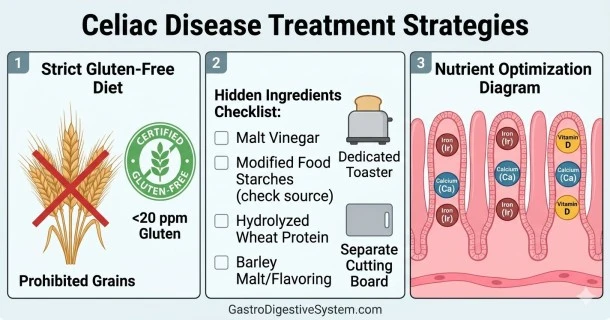
- Prohibited Grains: All native varieties and hybrids of wheat (including spelt, farro, kamut, and durum), rye, barley, and triticale must be permanently eliminated.
- The 20 PPM Standard: According to international regulatory standards, manufactured foods labeled "gluten-free" must contain a gluten concentration of less than 20 parts per million (ppm), a threshold clinically proven to be safe for the vast majority of celiac patients.
2. Cross-Contamination Risk Management
A major barrier to complete mucosal healing is inadvertent exposure to trace gluten. Implementing comprehensive cross-contamination risk management in celiac disease is vital for preventing persistent, low-grade small bowel inflammation.
- Household Safety: Shared kitchens require strict segregation of cooking environments. Dedicate separate toasters, cutting boards, and colanders for gluten-free preparation.
- Hidden Gluten Ingredients Checklist for Celiac: Carefully audit product labels for hidden sources of gluten derivatives:
- Malt Extracted Agents: Malt flavoring, malt vinegar, and barley malt syrup.
- Starch Fillers: Modified food starch (when derived from wheat and not explicitly declared), hydrolyzed wheat protein, and dextrin.
- Processing Aids: Emulsifiers, binders, stabilizers, and even wheat starch used as a processing agent in certain medications or supplements.
- Oats Caution: While pure oats are inherently gluten-free, standard commercial oats are heavily cross-contaminated in fields or processing facilities. Patients must source exclusively certified "gluten-free oats."
3. Addressing Micronutrient Deficiencies
Chronic villous atrophy severely impairs the small intestine's ability to absorb essential elements. Screening for and correcting micronutrient deficiencies in newly diagnosed celiac disease is a clinical priority during the first 6 to 12 months of rehabilitation.
- Iron Deficiency Anemia: Microcytic anemia due to proximal small bowel damage is frequently the primary presenting symptom of celiac disease.
- Fat-Soluble Vitamin Malabsorption: Deficiencies in Vitamins A, D, E, and K are common due to fat malabsorption. Vitamin D optimization is especially critical to safeguard bone mineral density and ward off osteopenia or osteoporosis.
- B-Complex and Minerals: Patients frequently require targeted supplementation of Calcium, Zinc, Folate, and Vitamin B12 until mucosal recovery is verified.
4. Refractory Celiac Disease (RCD) Management
When a patient demonstrates persistent clinical symptoms and severe villous atrophy despite 12 months of verified, strict gluten-free adherence, they are evaluated for Refractory Celiac Disease (RCD). Clinicians differentiate between two distinct forms:
| Clinical Feature | Refractory Celiac Disease Type 1 (RCD1) | Refractory Celiac Disease Type 2 (RCD2) |
|---|---|---|
| Intestinal T-Cell Profile | Normal, polyclonal intraepithelial lymphocytes (IELs). | Abnormal, monoclonal IELs with a loss of surface markers (CD3/CD8). |
| Clinical Severity | Typically milder; lower risk of immediate clinical deterioration. | Severe malabsorption, profound weight loss, and high risk of ulcerative jejunitis. |
| Malignancy Progression | Low risk of progression to lymphoma. | High risk of transforming into Enteropathy-Associated T-Cell Lymphoma (EATL). |
| Primary Treatment Modalities | Aggressive nutritional support, systemic corticosteroids (Prednisone), or immunomodulators (Azathioprine). | Open-label topical corticosteroids (Budesonide), chemotherapy, or clinical trials for targeted biologics. |
Frequently Asked Questions (FAQs)
Why is lifelong strict gluten-free diet compliance required if I have no symptoms?
Celiac disease is a silent autoimmune condition. Even if eating trace amounts of gluten does not cause immediate abdominal pain or diarrhea, it still triggers an internal T-cell response that destroys your small bowel's villi. Over time, this silent destruction leads to severe nutritional deficiencies, osteoporosis, and increased reproductive and oncological risks.
How do I identify hidden gluten ingredients on processed food labels?
Always scan labels for barley malt, malt vinegar, hydrolyzed wheat protein, wheat starch, and unspecified binders or modified food starches. Look for explicit "Certified Gluten-Free" labels or third-party verifications that confirm the item tests well below the mandatory 20 ppm threshold.
What is the prognosis for refractory celiac disease type 1 vs type 2 treatment?
The prognosis varies dramatically between the two types. Type 1 (RCD1) features normal T-cells and generally responds well to a combination of nutritional therapies and traditional immunosuppressants like corticosteroids. Type 2 (RCD2) is characterized by abnormal, clonal T-cells, carries a much higher risk of transforming into a severe form of lymphoma (EATL), and requires aggressive specialized oncological monitoring and advanced therapies.