
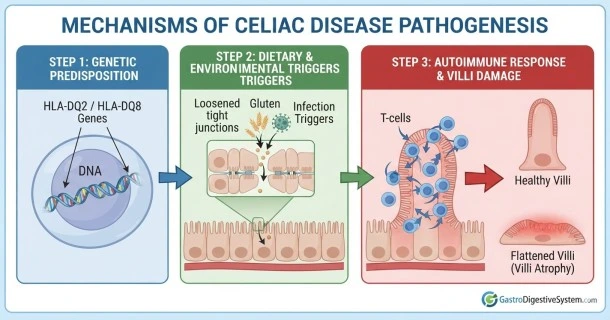
Explore the biological causes of celiac disease. Learn how the HLA-DQ2 and HLA-DQ8 genes combine with environmental triggers to cause autoimmune small bowel damage.
What Causes Celiac Disease? Genetics & Environmental Triggers
Celiac disease is caused by a complex interaction between genetic predisposition, exposure to dietary gluten, and specific environmental triggers. Unlike many standard gastrointestinal disorders, celiac disease cannot develop unless an individual carries specific hereditary genetic markers. However, carrying these genes alone is not enough to cause the disease; a distinct biological or environmental event is required to activate the autoimmune response.
1. The Genetic Blueprint: HLA-DQ2 and HLA-DQ8 Genes
The primary underlying cause of celiac disease is genetic. Human Leukocyte Antigens (HLA) are proteins found on the surface of white blood cells that help the immune system distinguish between the body's own cells and foreign invaders.
- The Critical Markers: Roughly 95% of individuals diagnosed with celiac disease carry the HLA-DQ2 gene, while most of the remaining 5% carry the HLA-DQ8 gene.
- The Screening Value: Because these genes are a strict prerequisite for the condition, a negative HLA genetic test virtually rules out a celiac disease diagnosis.
- The Genetic Paradox: While you must have these genes to develop celiac disease, carrying them does not guarantee you will get sick. Approximately 30% to 40% of the general population carries HLA-DQ2 or HLA-DQ8, yet only about 2% to 3% of those carriers ever go on to develop the actual condition.
2. The Dietary Trigger: Gluten Peptides
The secondary, indispensable cause of celiac disease is the ongoing ingestion of gluten.
- What is Gluten? Gluten is a structural protein composite composed of two primary fractions: gliadin and glutenin. It is found natively in wheat, rye, barley, and related grain hybrids.
- The Enzymatic Reaction: When gluten is consumed, digestive enzymes in the small bowel fail to fully break down gliadin. In genetically predisposed individuals, an enzyme called Tissue Transglutaminase (tTG) modifies these remaining gliadin peptides.
- The Autoimmune Strike: The modified gliadin binds strongly to the HLA-DQ2 or HLA-DQ8 receptors, mistakenly signaling the body’s T-cells to launch an aggressive immune attack against the small intestine's delicate lining.
3. Environmental and Epigenetic Activators
Because many people carry the celiac genes but remain perfectly healthy for decades, researchers have identified several environmental factors that can abruptly "turn on" or activate the disease later in life:
- Severe Gastrointestinal Infections: Bouts of viral or bacterial enteritis (such as Rotovirus or Campylobacter infections) during infancy or adulthood can cause temporary structural damage to the gut wall, activating a latent autoimmune response to gluten.
- Intestinal Permeability ("Leaky Gut"): Elevated levels of zonulin—a protein that modulates the tight junctions between cells lining the small bowel—can cause the intestinal barrier to loosen. This allows large, unmodified gliadin proteins to leak into the deeper layers of tissue, triggering an immune crisis.
- Early Childhood Feeding Timelines: While early clinical theories suggested that introducing gluten before 4 months or after 6 months altered risk profiles, modern multi-center studies show that the timing of initial gluten introduction does not significantly change overall celiac incidence, though it may delay the age of onset.
- Physical and Physiological Stressors: Major life shifts, such as pregnancy, childbirth, severe emotional trauma, or undergoing major abdominal surgery, can act as epigenetic catalysts that activate dormant autoimmune pathways..
Frequently Asked Questions (FAQs)
What are the main genes responsible for celiac disease?
The main genetic markers responsible for celiac disease are HLA-DQ2 and HLA-DQ8. Carrying at least one of these human leukocyte antigen markers is considered medically mandatory for developing the condition.
If I test positive for the HLA-DQ2 gene, do I have celiac disease?
No. Testing positive only means you have the genetic predisposition to develop celiac disease. Nearly 40% of healthy people carry this gene without ever getting sick. A positive gene test simply means celiac is possible; a blood antibody test or small bowel biopsy is required to confirm an active disease.
Can a viral infection cause celiac disease to start?
A viral infection cannot create celiac disease from scratch, but a severe gastrointestinal infection (like rotavirus) can act as an environmental trigger. The virus disrupts the intestinal lining, allowing gluten proteins to bypass the gut barrier and activate a latent autoimmune response in genetically vulnerable individuals.
What is zonulin, and how does it relate to celiac causes?
Zonulin is a signaling protein that controls the openings ("tight junctions") between the cells lining your small intestine. In celiac disease, exposure to gluten causes an abnormal overproduction of zonulin, forcing these junctions open. This increased intestinal permeability allows harmful gluten fragments to leak through and trigger an immune attack.
Is celiac disease passed down from mothers or fathers?
Celiac disease can be inherited from either parent. Because it is a polygenic hereditary trait linked to the HLA complex, having a first-degree relative (a mother, father, or sibling) with the condition gives an individual a 1-in-10 chance of developing it.