
Discover effective gastroparesis treatment options. Learn about the low-fat/low-fiber diet stages, prokinetic medications like metoclopramide, and J-tube nutrition.
Gastroparesis Treatment: Medications, Dietary Stages, and Advanced Therapies
Managing gastroparesis focuses on improving gastric motility, controlling debilitating symptoms like nausea and vomiting, and maintaining adequate systemic nutrition. Because delayed gastric emptying presents on a wide spectrum of clinical severity, treatment typically begins with strategic dietary restructuring before advancing to targeted prokinetic medications or surgical interventions.
Under strict medical supervision, a combined approach helps restore fluid balance, optimize glycemic control in diabetic patients, and allow the gastric mucosa to process nutrients efficiently.
1. Evidence-Based Dietary Management (The Core Foundation)
Dietary modification is the first-line defense for gastroparesis management. Reducing the mechanical workload of the stomach wall is essential for minimizing postprandial fullness and bloating.
Structural Food Rules
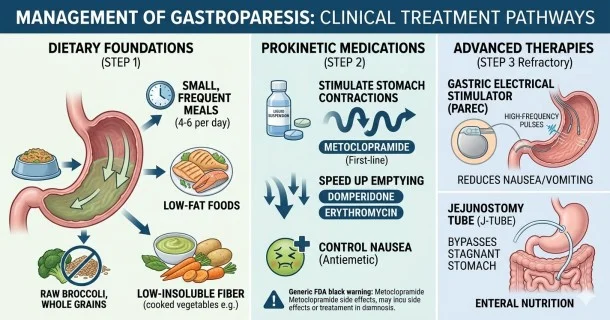
- Consume Small, Frequent Meals: Transition from three large daily meals to 4 to 6 small-volume nutrient portions spaced evenly throughout the day to prevent stomach distension.
- Restrict Insoluble Fibers: Avoid high-fiber foods (like raw broccoli, bran, and whole grains). Soluble fiber is acceptable, but insoluble fiber cannot be easily broken down by a weak stomach, sharply increasing the risk of a solid mass blockage (bezoar).
- Minimize Fat Intake: Restrict heavy, fatty meats and deep-fried items. Dietary fats naturally release hormones that further delay gastric emptying.
- Embrace the Liquid Shift: If solid food triggers immediate vomiting, shift your caloric intake toward nutrient-dense liquids, homogenized purees, or smooth blenderized meals which pass through the pylorus using gravity alone.
2. Pharmacological Interventions for Gastric Motility
When nutritional adjustments are insufficient, gastroenterologists prescribe medications to stimulate stomach contractions or block central nausea pathways.
Prokinetic Agents (Motility Stimulants)
- Metoclopramide: The primary first-line prokinetic therapy that carries both motility-stimulating and antiemetic properties. To maximize absorption, it is best administered in liquid form 30 minutes before meals and at bedtime.
- Critical FDA Warning: Metoclopramide carries a strict Black Box Warning due to the risk of extrapyramidal side effects, most notably tardive dyskinesia (uncontrollable, repetitive movements of the face, tongue, or extremities). The risk increases with treatment duration; hence usage is typically capped at a maximum of 12 weeks.
- Domperidone: Offers similar upper-gut motility stimulation and antroduodenal coordination without crossing the blood-brain barrier. Because it does not enter the central nervous system, it carries a much lower risk of extrapyramidal side effects or tardive dyskinesia than metoclopramide.
- Erythromycin: A broad-spectrum antibiotic that acts as a potent motilin receptor agonist, triggering intense gastric contractions. It is frequently given as a liquid suspension for acute flare-ups. However, its long-term clinical utility is highly limited by tachyphylaxis—a rapid, sudden decrease in drug effectiveness over a short period.
Antiemetic and Support Medications
- Serotonin (5-HT3) Antagonists: Medications like ondansetron provide excellent control for severe nausea flare-ups. They are best utilized on an as-needed basis.
- Neuromodulators (Tricyclic Antidepressants): Low-dose tricyclic compounds (such as nortriptyline or amitriptyline) are prescribed at bedtime. While they do not speed up gastric emptying, they safely alter visceral pain pathways to relieve chronic abdominal pain and refractory nausea.
3. Advanced Enteral Nutrition and Surgical Therapies
For refractory gastroparesis patients experiencing severe malnutrition, recurrent hospitalizations, or a loss of more than 10% of their baseline body weight within six months, advanced interventions become clinically necessary:
Enteral Feeding Tubes
- Jejunostomy Tubes (J-Tubes): A surgical procedure where a feeding tube is placed directly into the second section of the small intestine (the jejunum). This allows nutrient-dense liquid formulas to completely bypass the stagnant stomach, starting at low infusion rates (e.g., 20 mL/h) and slowly advancing to safely fulfill daily caloric goals.
Surgical and Electrical Interventions
- Gastric Electrical Stimulation (Gastric Pacer): An implantable neurostimulator placed within a subcutaneous abdominal pouch. It delivers high-frequency, low-energy electrical pulses to the gastric muscular wall along the greater curvature, helping reduce chronic, intractable nausea.
- Surgical Pyloroplasty: A corrective procedure that surgically widens the pyloric sphincter valve, lowering exit resistance so that stagnant food can move more freely into the small intestine.
Frequently Asked Questions (FAQ)
What is the FDA black box warning associated with metoclopramide for gastroparesis?
Metoclopramide carries a strict FDA black box warning due to its risk of causing extrapyramidal neurological side effects, specifically tardive dyskinesia. This condition causes involuntary, permanent muscle movements of the face, lips, tongue, or limbs. Because the risk increases significantly the longer the drug is taken, clinicians typically restrict continuous metoclopramide therapy to less than 12 weeks.
Why does the prokinetic drug erythromycin lose its effectiveness over time?
Erythromycin is a powerful stimulant that binds to motilin receptors to trigger intense stomach contractions. However, long-term oral usage causes a clinical phenomenon known as tachyphylaxis, where the body's cell receptors rapidly desensitize and stop responding to the drug. To prevent this sudden loss of effectiveness, doctors often reserve erythromycin for short-term acute flare-ups or use it intermittently.
Why must a gastroparesis diet strictly limit high-fiber foods?
While high-fiber foods are generally healthy, individuals with gastroparesis must strictly avoid insoluble fibers (like raw vegetables, skins, and hulls). Because a paretic stomach cannot generate the strong grinding waves needed to break down dense fibers, these materials can collect and harden inside the gastric cavity over time, forming a dangerous physical blockage known as a gastric bezoar.