
Wondering what causes giardiasis? Discover how the Giardia parasite spreads through contaminated water, food, and surface surfaces, and how transmission happens.
Giardiasis Causes and Transmission
Giardiasis is an intestinal infection directly caused by the microscopic protozoan parasite Giardia duodenalis (also classified as Giardia lamblia or Giardia intestinalis). Understanding the precise root causes and modes of transmission is essential for preventing infection and halting its spread within communities.
The primary cause of infection is the accidental ingestion of Giardia cysts. Because these dormant cysts possess a rigid, protective outer shell, they can survive in environmental water or soil for several months and easily withstand standard chlorine chemical treatments.
1. Primary Modes of Transmission
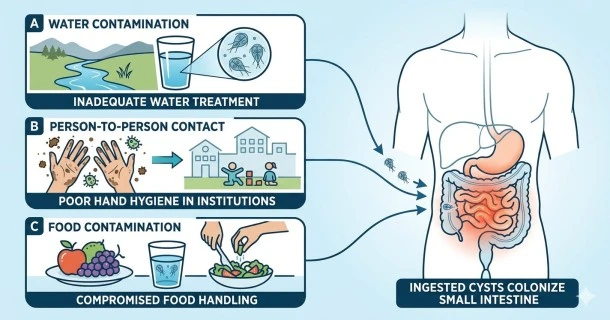
The parasite spreads via the fecal-oral route, meaning that microscopic traces of feces from an infected human or animal inadvertently enter the mouth of another person. This occurs through several common pathways:
- Contaminated Water Consumption: This is the most prevalent cause of outbreak clusters. Ingestion frequently happens when drinking untreated surface water from wilderness streams, rivers, and lakes while hiking or camping. It can also occur in urban areas if local water treatment facilities malfunction, or in rural areas through shallow, poorly protected agricultural wells.
- Recreational Water Exposure: Accidentally swallowing water while swimming in public pools, hot tubs, water parks, lakes, or water features can introduce the parasite. If an infected individual contaminates the water, standard pool chlorine levels are often insufficient to kill the resilient cysts immediately.
- Person-to-Person Spread: Direct contact with infected individuals is a common driver of localized transmission. This is frequently observed in institutional settings like daycare centers, where childcare workers change diapers, or in nursing homes, if strict hand hygiene protocols are not rigorously maintained.
- Contaminated Food Handling: Eating raw fruits or vegetables that were washed or irrigated with contaminated water can transmit the illness. Similarly, food service workers infected with the parasite can transfer cysts onto ready-to-eat meals if they do not thoroughly wash their hands.
2. The Host Reservoir: Animals and Humans
Humans are the primary hosts for the specific strains of Giardia that cause widespread human illness. However, certain animals also serve as environmental reservoirs:
- Wildlife: Animals such as beavers are notorious for shedding Giardia cysts into wilderness waterways, earning the illness its colloquial nickname, "beaver fever."
- Domesticated Animals: Dogs, cats, livestock, and cattle can carry and shed various strains of the parasite. While zoonotic (animal-to-human) transmission is less common than human-to-human spread, direct exposure to infected pet feces remains a potential risk factor.
3. How Ingestion Leads to Infection
Once a host swallows the microscopic cysts, the parasite undergoes a strategic transition inside the digestive tract:
- Gastric Activation: The high acidity of the stomach breaks down the cyst's protective shell, releasing active, free-moving parasites known as trophozoites.
- Small Intestine Colonization: The trophozoites travel to the small intestine, using specialized sucking disks to attach tightly to the intestinal wall, where they reproduce rapidly and trigger the classic symptoms of malabsorption and gastrointestinal distress.
Frequently Asked Questions (FAQs)
What is the root cause of giardiasis?
The root cause of giardiasis is the accidental ingestion of the microscopic parasite Giardia duodenalis. The infection initiates when a person consumes food or water contaminated with the parasite's dormant, hardy cysts.
Can you get Giardia from tap water?
While rare in regions with modern, properly regulated municipal water systems, tap water can cause giardiasis if there is a sanitation breakdown, an agricultural runoff overflow, or if the water relies on shallow well systems that have been compromised by nearby sewage or animal waste.
Is Giardia spread through the air or coughing?
No, Giardia is not an airborne pathogen and cannot be transmitted via coughing, sneezing, or breathing the same air. It is spread strictly through the fecal-oral route, meaning the parasite must be physically swallowed to cause infection.
How easily does Giardia spread between family members?
Giardia spreads very easily within households. Because the infectious dose is remarkably low—meaning swallowing just a few microscopic cysts can make a person sick—poor hand hygiene after using the restroom or before preparing meals can quickly pass the infection to other family members.