
Learn how doctors accurately diagnose SIBO. Discover the differences between lactulose and glucose breath tests, positive criteria thresholds, and testing prep.
How Do You Test for SIBO? Diagnostic Methods & Preparation Guide
Diagnosing Small Intestinal Bacterial Overgrowth (SIBO) relies primarily on non-invasive breath tests that measure the fermentation of specific sugars by gut bacteria. Because standard stool tests cannot look inside the small bowel, specialized diagnostic testing is required to identify elevated gas levels and determine your specific SIBO subtype.
The Main Diagnostic Tests for SIBO
Clinicians rely on two primary methods to evaluate the small intestine for bacterial overgrowth, along with an invasive standard used less frequently in routine practice.
1. Hydrogen and Methane Breath Testing (Most Common)
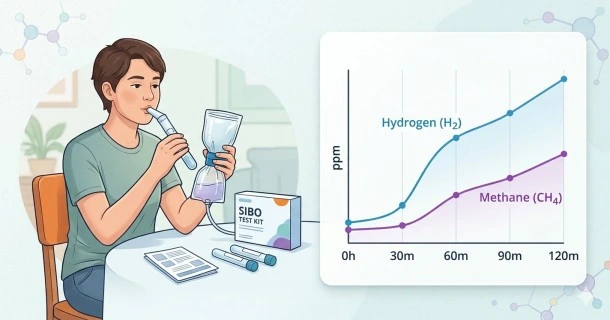
The primary clinical method for diagnosing SIBO involves drinking a sugar solution—either lactulose or glucose—and collecting breath samples at regular intervals (usually every 15 to 20 minutes) for 2 to 3 hours. Human cells cannot produce hydrogen or methane gas; these are solely byproduct gases of bacterial fermentation.
- Glucose Breath Test (GBT): According to clinical guidelines hosted by the Cleveland Clinic, glucose is highly accurate because it is rapidly absorbed in the proximal small bowel. If bacteria ferment it before absorption, it signifies an overgrowth. However, it may miss overgrowths located further down in the distal small intestine.
- Lactulose Breath Test (LBT): Humans cannot absorb lactulose, allowing it to travel through the entire length of the small intestine. This makes it effective at capturing distal overgrowths, though it can sometimes produce a false positive if a patient has a naturally rapid gut transit time, as highlighted in studies on PubMed Central.
2. Small Bowel Aspirate and Fluid Culture
This invasive procedure requires an upper endoscopy. A gastroenterologist passes a tube through the stomach into the duodenum or jejunum to collect a sample of intestinal fluid, which is then cultured in a lab.
- Why it's rarely used: It is costly, highly invasive, requires sedation, and can miss overgrowths that are patchy or located deeper in the small bowel.
Understanding SIBO Subtypes & Positive Criteria
According to established consensus guidelines for breath testing, a SIBO diagnosis is verified based on specific gas thresholds measured in parts per million (ppm):
- Hydrogen-Dominant SIBO: A rise in hydrogen gas of \(\ge \) 20 ppm from baseline within 90 minutes of taking the substrate.
- Methane-Dominant SIBO (Intestinal Methanogen Overgrowth / IMO): A methane concentration of \(\ge \) 10 ppm at any point during the test.
- Hydrogen Sulfide SIBO: Characterized by a distinct elevation in hydrogen sulfide gas, typically measured using newer triple-gas breath testing kits.
Crucial SIBO Test Preparation Rules
To prevent false results, patients must adhere strictly to a rigorous preparation protocol before testing:
- 14 Days Before: Stop taking all antibiotics, herbal antimicrobials, and colonoscopy preps.
- 7 Days Before: Avoid prokinetics and laxatives unless directed by a physician.
- 24 Hours Before: Eat a strict, low-fermentable diet consisting only of baked chicken or turkey, white rice, eggs, and water.
- 12 Hours Before: Complete a strict fast (water only) up until the start of the test.
Frequently Asked Questions (SIBO Diagnosis FAQ)
Which is better for SIBO testing: glucose or lactulose?
Both have distinct benefits. A glucose breath test has higher specificity, meaning fewer false positives, but it can miss overgrowths at the end of the small intestine. A lactulose breath test spans the entire small bowel but carries a slightly higher risk of false positives if your digestive transit is exceptionally fast.
Can a standard stool test diagnose SIBO?
No. Stool tests measure the microbial composition of the large intestine (colon). Because SIBO occurs in the small intestine—an entirely separate upstream region—stool samples cannot accurately reflect the bacterial load or gas production within the small bowel.
What happens if I don't follow the SIBO test diet prep?
Failing to follow the pre-test diet can lead to highly inaccurate results. Residual fermentable fibers from a normal diet will feed the bacteria during your test, triggering premature gas spikes that mimic SIBO, resulting in a false positive.
How long does it take to get SIBO breath test results?
If the test is performed at a clinic, baseline results are sometimes available immediately. If you use an at-home breath testing kit, it typically takes 3 to 7 business days after the lab receives your mailed samples to generate the final analytical report.