
What causes tropical sprue? Explore the post-infectious bacterial mechanisms, critical geographic risk factors, and environmental triggers behind this small bowel disease.
What Causes Tropical Sprue? Etiology, Risk Factors, and Triggers
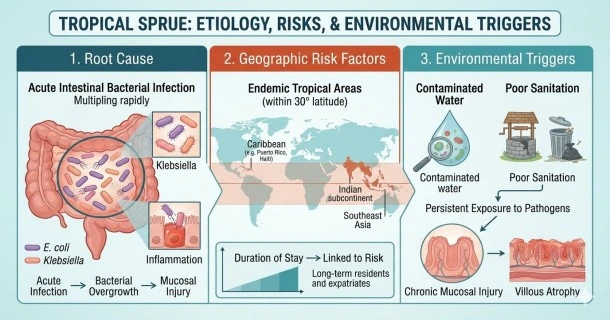
The exact cause of Tropical Sprue is multifactorial, stemming primarily from a post-infectious microbial disruption that triggers persistent small intestinal bacterial overgrowth (SIBO). While historical theories inaccurately tied the condition to toxic dietary fats or primary nutritional deficiencies, modern clinical evidence confirms it is an acquired environmental disease. A temporary stomach or intestinal infection initiates damage to the small bowel lining, shifting the resident microbiome and halting the body’s ability to process food.
The Biological Causes & Pathogenesis
Medical consensus indicates that Tropical Sprue originates as a prolonged, abnormal reaction to an initial bacterial, viral, or parasitic gastrointestinal infection. The biological mechanism unfolds across three distinct clinical phases:
- The Initiating Insult (Acute Infection): An individual contracts a typical foodborne or waterborne diarrheal illness while residing in or traveling through a tropical environment.
- Mucosal Injury & Intestinal Stasis: The acute pathogen injures the enterocytes (cells lining the small intestine). This cellular trauma delays intestinal motility, meaning food and liquids move through the digestive tract too slowly.
- Coliform Bacterial Overgrowth: Due to this intestinal stasis, specific aerobic coliform bacteria multiply excessively in the proximal small bowel. The specific bacteria isolated from affected individuals include:
- Escherichia coli (E. coli)
- Klebsiella pneumoniae
- Enterobacter cloacae
These overpopulated bacteria continuously ferment nutrients, producing toxins that persistently blunt and destroy the microscopic intestinal villi. This chronic injury creates a destructive loop: the flattening of the villi decreases nutrient absorption, and the resulting severe folate deficiency prevents the intestinal lining from regenerating or healing itself.
Critical Risk Factors
Tropical Sprue does not occur globally; its presence is bound tightly to specific geographic and demographic risk factors:
- Geographic Bound: It is almost exclusively found in tropical and subtropical regions located within 30 degrees north and south of the equator. Highly endemic areas include the Caribbean islands (notably Puerto Rico, Haiti, and Cuba), the Indian subcontinent, Southeast Asia, and parts of Central and South America. Interestingly, it is exceptionally rare in tropical Africa.
- Duration of Exposure: Long-term residents, expatriates, and immigrants from endemic areas are at the highest risk. For travelers, risk correlates directly with time; it rarely presents in tourists spending less than a month in a tropical zone, typically requiring an extended stay to manifest.
Environmental Triggers
While anyone exposed to coliform bacteria in the tropics can theoretically develop the disease, specific environmental triggers accelerate or worsen the condition:
- Poor Water, Sanitation, and Hygiene (WASH) Infrastructure: Relying on untreated drinking water or consuming raw produce washed in contaminated water serves as a primary vector for the initial microbial infection.
- Persistent Environmental Enteropathy: Regular, low-grade exposure to fecal bacteria in areas with sub-optimal sanitation causes chronic, underlying gut inflammation. This leaves the small intestine highly vulnerable to long-term bacterial overgrowth if an acute infection strikes.
Frequently Asked Questions (FAQs)
Can you pass Tropical Sprue to someone else?
No. While the initial bacterial pathogens (like E. coli or Klebsiella) can be transmitted via contaminated food or water, Tropical Sprue itself is an individual, abnormal post-infectious colonization and malabsorptive response. The chronic syndrome is not contagious.
Why does Tropical Sprue happen in some tropical regions but not others?
The precise reason for this regional variation remains an active area of medical research. It is suspected to stem from variations in localized strains of coliform bacteria, distinct differences in regional dietary compositions, or subtle genetic variations in how different populations react to specific intestinal infections.
How do antibiotics cure a condition caused by environmental factors?
Because the primary driver of chronic villous atrophy is the persistent overgrowth of coliform bacteria inside the small bowel, a long-term course of broad-spectrum antibiotics (typically tetracycline) is highly effective. Eradicating these bacteria eliminates the persistent cellular toxins, allowing the small intestine to heal.
Does a folate deficiency cause Tropical Sprue or result from it?
Current clinical evidence indicates that a folate deficiency is a consequence of the disease rather than its root cause. However, once malabsorption flattens the villi and triggers a severe folate deficiency, the body loses the building blocks needed to repair the gut lining, which perpetuates the chronic symptoms until targeted supplements are introduced.