
Understand the medical basics of infectious enteritis. Explore how viral, bacterial, and parasitic paths inflame the small bowel and alter fluid absorption.
What Is Infectious Enteritis? An Introduction to Small Bowel Infections
Infectious enteritis is an acute inflammation of the small intestine caused by the invasion and multiplication of pathogenic microorganisms, including viruses, bacteria, or parasites. While often colloquially grouped under general "stomach flu," enteritis specifically targets the small bowel—the critical region responsible for nutrient absorption and fluid regulation.
When pathogens breach your gut's defensive barriers, they irritate the intestinal mucosa, leading to standard gastrointestinal distress, rapid fluid loss, and systemic immune responses.
Classifications: The 3 Main Types of Enteritis Pathogens
Medical professionals classify infectious enteritis based on the type of invading microbe. Each leaves a distinct pathological footprint on the small intestine:
1. Viral Enteritis
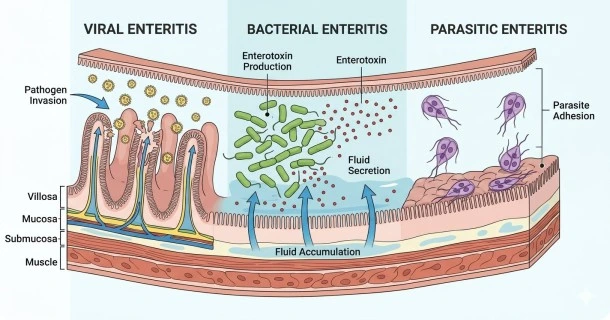
Viral invasions are the most common cause of acute intestinal inflammation worldwide, especially in pediatric populations. According to clinical data from the Cleveland Clinic, viruses damage the tips of the villi (microscopic finger-like projections), temporarily reducing the small intestine's surface area.
- Primary Culprits: Rotavirus, Norovirus, and Adenovirus.
- Mechanism: They hijack host epithelial cells, causing them to rupture and compromise nutrient absorption.
2. Bacterial Enteritis
Bacterial infections are typically more severe than viral variants and are frequently tied to contaminated food or water supply chains.
- Primary Culprits: Salmonella, Campylobacter, Shigella, and Escherichia coli.
- Mechanism: Certain strains produce enterotoxins that force cellular fluid out into the bowel lumen, while others directly invade and destroy the intestinal lining, as detailed in literature on PubMed Central.
3. Parasitic Enteritis
Parasitic infections tend to linger longer than viral or bacterial episodes, occasionally manifesting as subacute or chronic small bowel issues.
- Primary Culprits: Giardia duodenalis and Cryptosporidium.
- Mechanism: Parasites physically adhere to the brush border of the small bowel, forming a physical barrier that prevents normal enzyme function and macro-nutrient breakdown.
Pathophysiology: How It Impacts Your Small Bowel
The small intestine's primary role is absorbing water, electrolytes, and broken-down food. Infectious enteritis disrupts this mechanism in two ways:
[Pathogen Invasion] ──> [Mucosal Epithelial Damage]
│
├─> Secretory: Toxins force rapid fluid secretion into bowel
└─> Malabsorptive: Damaged villi cannot absorb water/nutrients
│
[Result: Acute Diarrhea & Dehydration]
- Secretory Mechanisms: Bacterial toxins stimulate the overproduction of cyclic AMP inside host cells, prompting a massive excretion of chloride ions and water directly into the digestive tract.
- Malabsorptive Mechanisms: Structural damage to the intestinal villi leaves the body unable to process incoming carbohydrates and fluids, leading to osmotic pressure that pulls even more water into the stools.
Clinical Diagnostic & Management Framework
Confirming an enterprise-level infection in the small bowel follows a structured medical framework focused on pathogen identification and immediate systemic stability.
- Advanced Diagnostics: Clinicians rely heavily on stool cultures, microscopy for ova and parasites, and highly sensitive Multiplex Polymerase Chain Reaction (PCR) panels to rapidly decode the pathogen's DNA.
- Primary Medical Intervention: According to peer-reviewed protocols in Current Treatment Options in Gastroenterology, the cornerstone of management is aggressive fluid and electrolyte repletion. Antibiotics are rarely used empirically unless a severe bacterial strain is definitively isolated or the patient is immunocompromised.
Explore Further
To view comprehensive breakdowns of related clinical metrics, navigate to our dedicated guides:
- Infectious Enteritis Symptoms & Warning Signs
- Root Causes & Transmission Pathways
- Infectious Enteritis diagnosis
- Infectious Enteritis treatment
Frequently Asked Questions (Infectious Enteritis FAQ)
What is the exact medical definition of enteritis?
Enteritis is specifically defined as the inflammation of the small intestine. While "gastroenteritis" involves both the stomach and the intestines, true enteritis isolates its pathological effects within the duodenum, jejunum, and ileum, directly interfering with essential nutrient uptake.
How does enteritis differ from standard colitis?
The distinction lies entirely in the anatomical location. Enteritis is inflammation isolated to the small intestine, whereas colitis refers exclusively to inflammation of the large intestine (colon). They present with distinct clinical markers, fluid loss patterns, and complication profiles.
Is infectious enteritis highly contagious?
Yes. Most pathogens responsible for infectious enteritis spread readily via the fecal-oral route. This occurs through direct contact with contaminated surfaces, consuming contaminated food or water, or inadequate hand hygiene after utilizing the restroom or changing diapers.
How long does an acute bout of infectious enteritis typically last?
Viral and bacterial enteritis usually run an acute course, resolving within 3 to 7 days with adequate supportive hydration care. Parasitic variations, however, are notorious for lingering for multiple weeks or months if left undiagnosed and untreated with targeted anti-parasitic therapeutics.