
How is rapid gastric emptying diagnosed? Learn about the Sigstad scoring index, gastric emptying scintigraphy scans, and glucose tolerance tests.
Rapid Gastric Emptying Diagnosis: Tests for Dumping Syndrome
Securing a definitive rapid gastric emptying diagnosis requires moving beyond a baseline symptom assessment. Because the post-meal distress caused by Dumping Syndrome can strongly mimic other gastrointestinal issues, clinical specialists rely on objective, physiological testing to confirm accelerated stomach transit.
If you or a loved one are experiencing severe post-meal cramping, dizziness, or sweating, a gastroenterologist will typically guide you through a structured, multi-step diagnostic evaluation. This path combines standardized clinical questionnaires with advanced nuclear medicine imaging and glucose monitoring.
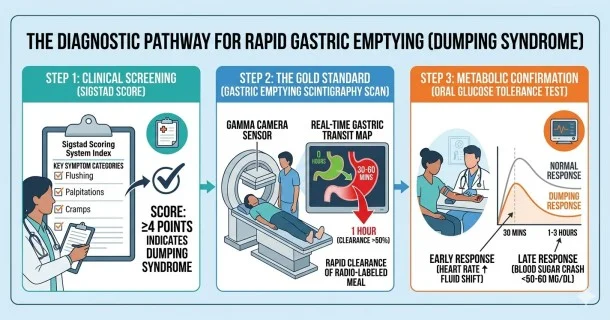
1. Clinical Screening: The Sigstad Scoring System
Before ordering invasive or expensive diagnostic tests, many gastroenterologists utilize a standardized clinical screening tool called the Sigstad Scoring System. This point-based index assigns specific values to your physical reactions within the hours following a meal.
- Symptom Scoring: Distinct points are added for specific signs, such as skin flushing, palpitations, abdominal fullness, or dizziness.
- Diagnostic Threshold: A total score of 4 or higher strongly indicates the presence of clinical dumping syndrome, providing your medical team with the statistical justification needed to order specialized physiological scans.
2. The Gold Standard: Gastric Emptying Scintigraphy Scan
The primary test used to definitively diagnose rapid gastric emptying is a gastric emptying scintigraphy scan. This non-invasive nuclear medicine test provides a real-time, moving image of your stomach’s digestive timeline.
What to Expect During the Test
- The Radio-Labeled Meal: You will be asked to eat a standardized, low-fat solid meal—typically consisting of scrambled egg whites, toast, and water—that has been mixed with a safe, tiny amount of a radioactive tracer called technetium-99m.
- Nuclear Camera Imaging: You will stand or sit in front of a specialized gamma camera. This machine detects the radiation emitted by the tracer without releasing harmful radiation into your body.
- Continuous Tracking: The camera takes immediate images of your stomach area and repeats these scans at set intervals (typically at 0, 1, 2, and 4 hours) to track exactly how fast the food leaves your stomach.
Interpreting the Results for Rapid Transit
While a standard scan looks for delayed emptying (gastroparesis), a diagnosis of rapid gastric emptying is confirmed if the stomach empties much faster than normal thresholds. Specifically, clinicians look for:
- An abnormally low percentage of food remaining in the stomach after just 30 to 60 minutes.
- More than 50% of the meal clearing the stomach within the very first hour post-consumption.
3. Evaluating Metabolic Responses: Oral Glucose Tolerance Test
To explicitly evaluate for late dumping syndrome and its defining trait—reactive hypoglycemia—physicians utilize a specialized variant of the Oral Glucose Tolerance Test (OGTT).
- The Test Protocol: After fasting overnight, your baseline blood sugar, hematocrit, and heart rate are recorded. You will then drink a highly concentrated solution containing 50 grams of pure glucose. Your blood levels and heart rate will be checked at regular intervals over the next three hours.
- Confirming Early Phase Markers: A sudden increase in heart rate (by more than 10 beats per minute) or a sharp rise in hematocrit within the first 30 minutes indicates the acute fluid shift characteristic of early dumping syndrome.
- Confirming Late Phase Markers: A dramatic drop in blood glucose levels—typically falling below 50 to 60 mg/dL between 1 and 3 hours post-drink—confirms a diagnosis of reactive hypoglycemia driven by late rapid gastric emptying.
Differential Diagnosis: What Must Be Ruled Out?
Because rapid gastric emptying presents with a wide array of systemic and digestive signs, your medical team must perform a careful differential diagnosis to rule out other serious conditions:
- Mechanical Bowel Obstructions: Ruled out via an upper endoscopy (EGD) or CT scan to ensure a physical blockage isn't forcing rapid liquid bypass.
- Pheochromocytoma: A rare adrenal tumor that causes sudden spikes in adrenaline, mimicking the sweating and rapid heart rate of late dumping. This is ruled out through specific urine or blood hormone tests.
- Insulinoma: A rare pancreatic tumor that produces excessive insulin independently of food intake, causing unexplained low blood sugar.
Frequently Asked Questions (FAQ)
Do you need to stop taking medications before a gastric emptying scan?
Yes, you will typically need to stop taking certain medications under your doctor's supervision for 48 to 72 hours before a gastric emptying scintigraphy scan. Medications that accelerate stomach motility (prokinetics) or drugs that slow down digestion (like opioids or anticholinergics) can artificially alter your transit times, leading to an inaccurate test result.
Is the radioactive tracer used in a gastric emptying scan dangerous?
No, the radioactive tracer used during a gastric emptying scan is highly safe. The dose of technetium-99m used is extremely small, resulting in a radiation exposure level comparable to, or less than, a standard screening X-ray. The tracer does not alter the taste of the food and passes out of your body naturally through your urine within 24 hours.
What is the main difference between testing for gastroparesis and testing for rapid gastric emptying?
Both conditions are diagnosed using the exact same gastric emptying scintigraphy scan, but they represent opposite ends of the digestive spectrum. Testing for gastroparesis looks for abnormally delayed transit, where a large percentage of food remains stuck in the stomach after 4 hours. Testing for rapid gastric emptying focuses heavily on the initial 30 to 60 minutes to see if the stomach is emptying abnormally fast.