
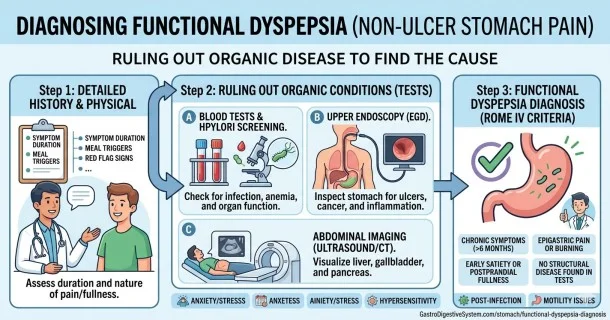
How is functional dyspepsia diagnosed? Learn about the Rome IV clinical criteria, upper endoscopy procedures, H. pylori testing, and gastric emptying studies.
Functional Dyspepsia Diagnosis: Tests & Rome IV Criteria
Securing a definitive functional dyspepsia diagnosis requires a thorough and careful medical investigation. Because the chronic upper stomach burning, pain, and early fullness characteristic of Functional Dyspepsia (FD) overlap perfectly with structural conditions like peptic ulcers or stomach cancers, a clinical diagnosis can only be made through a meticulous process of exclusion.
If you are experiencing persistent indigestion, your gastroenterologist will utilize a combination of clinical guidelines, direct visualization testing, and specialized screening to confirm that your symptoms are functional rather than organic.
1. The Gold Standard: The Rome IV Diagnostic Criteria
To establish a baseline diagnosis for functional dyspepsia without relying on guesswork, the international medical community utilizes the Rome IV Clinical Criteria. Under these guidelines, a patient must meet specific symptom thresholds to validate a diagnosis of a disorder of gut-brain interaction (DGBI).
Standard Diagnostic Thresholds
A patient must have experienced at least one of the following four core symptoms for the past 3 months, with an overall symptom onset stretching back at least 6 months prior to diagnosis:
- Bothersome Postprandial Fullness: A heavy sensation of food sitting in the upper abdomen.
- Early Satiety: Feeling prematurely full after a few bites of a normal meal.
- Epigastric Pain: A localized, painful ache in the upper center of the stomach.
- Epigastric Burning: A localized heat sensation below the ribs.
Additionally, there must be no evidence of structural disease on a routine upper endoscopy to explain the symptoms.
2. Essential Diagnostic Procedures (Ruling Out Organic Disease)
Because functional dyspepsia means your stomach tissue is structurally intact but functionally hyper-reactive, a physician must perform diagnostic tests to actively rule out alternative "organic" conditions.
Upper Gastrointestinal Endoscopy (EGD)
An upper endoscopy is the most critical procedure in the diagnostic path. A gastroenterologist inserts a thin, flexible tube equipped with a tiny camera down your esophagus and into the stomach cavity.
- What It Rules Out: This test looks directly at the tissue to rule out physical peptic ulcer disease, severe erosive gastritis, esophageal strictures, hiatal hernias, and gastric malignancies.
- Biopsy Testing: During the endoscopy, small tissue samples (biopsies) are often taken to check for microscopic abnormalities.
Helicobacter pylori Screening
An active infection by the bacterium Helicobacter pylori can cause identical symptoms of chronic burning and epigastric pain. Testing is crucial because an H. pylori infection can be cured with targeted antibiotics, whereas true FD requires nerve-desensitizing or motility therapies.
- Testing Methods: This can be performed during an endoscopy biopsy, via a non-invasive urea breath test, or through a standardized stool antigen test.
- Clinical Distinction: If a patient tests positive for H. pylori and their symptoms resolve completely after taking antibiotics, their official diagnosis is an H. pylori-associated dyspepsia. If their symptoms persist long after the bacteria are eradicated, they are diagnosed with true functional dyspepsia.
3. Differentiating FD from Gastroparesis: Gastric Emptying Study
A major challenge in neurogastroenterology is differentiating the Postprandial Distress Syndrome (PDS) subtype of functional dyspepsia from gastroparesis (delayed gastric emptying), as both conditions cause identical symptoms of severe bloating, early satiety, and post-meal fullness.
- The Test: A Gastric Emptying Study (GES) is ordered. The patient eats a standardized meal containing a tiny, safe amount of a radioactive tracer, and a gamma camera tracks how fast the stomach clears the food over a 4-hour window.
- The Diagnostic Verdict: If the scan shows that food is clearing at a normal, healthy rate, the symptoms are confirmed as functional dyspepsia driven by nerve hypersensitivity or poor muscle relaxation. If the scan displays a documented physical delay in clearing food, the condition is diagnosed as gastroparesis.
The Checklist of "Alarm Features"
During your evaluation, your doctor will scan your history for critical clinical "red flags" or alarm features. If any of these are present, it prompts immediate, aggressive diagnostic imaging to rule out advanced structural emergencies:
- Unexplained, progressive weight loss
- Persistent, uncontrollable vomiting
- Signs of GI bleeding (vomiting blood or passing black, tarry stools)
- Pain or difficulty when swallowing food (dysphagia)
- New, sudden onset of severe indigestion in individuals over the age of 50 to 55
Frequently Asked Questions (FAQ)
Can you be diagnosed with functional dyspepsia if your endoscopy shows mild gastritis?
Yes, it is very common. Many routine endoscopy biopsies show very mild, superficial gastritis (minor surface irritation). If the level of irritation found is too minor to logically explain the severity of your chronic burning and pain, your gastroenterologist will still make a diagnosis of functional dyspepsia, treating the issue as a neurological disorder of gut-brain interaction rather than a tissue-injury issue. [1, 2]
Why do I need a breath test for H. pylori if I already had a normal endoscopy?
If your doctor did not take a tissue biopsy during your upper endoscopy, a separate urea breath test or stool antigen test is required to rule out Helicobacter pylori. This bacterium lives deep inside the protective mucus coating of the stomach wall. It can cause severe nerve irritation and burning even if the stomach surface looks completely healthy and free of physical ulcers during a visual camera inspection.
What is the main difference between functional dyspepsia and gastroparesis testing?
While both conditions cause early satiety and heavy bloating, they are distinguished by a Gastric Emptying Study (GES). Patients with functional dyspepsia experience intense indigestion symptoms despite having a completely normal stomach emptying rate, meaning their pain is caused by hyper-sensitive nerves or poor muscle relaxation. Gastroparesis patients have a physically documented, mechanical delay where food remains physically stuck in the stomach for hours.