
What does functional dyspepsia feel like? Explore the distinct symptoms of non-ulcer indigestion, including early satiety, post-meal fullness, and epigastric burning.
Functional Dyspepsia Symptoms: Signs of Non-Ulcer Indigestion
Identifying functional dyspepsia symptoms requires looking closely at how and when your upper stomach discomfort occurs. Because these symptoms can easily mimic other digestive conditions, like a physical peptic ulcer or gastroesophageal reflux disease (GERD), tracking the exact relationship between your discomfort and your meals is vital for a correct medical evaluation.
Gastroenterologists diagnose and categorize these symptoms using the Rome IV Clinical Criteria. Under this framework, non-ulcer indigestion is divided into two primary symptom patterns: Postprandial Distress Syndrome (PDS) and Epigastric Pain Syndrome (EPS).
1. Postprandial Distress Syndrome (PDS) Symptoms
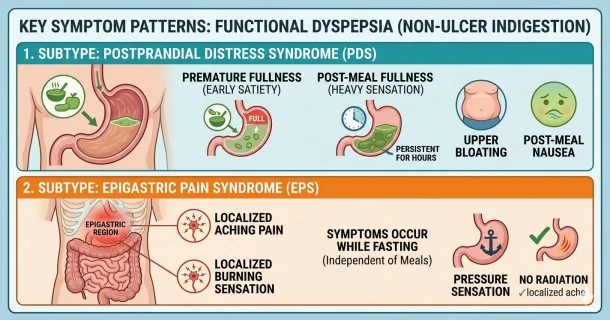
The PDS subtype is defined by symptoms that are directly brought on, or made significantly worse, by eating a normal-sized meal. The underlying mechanics are usually related to abnormal stomach muscle relaxation or slowed movement.
Key clinical signs include:
- Bothersome Postprandial Fullness: A persistent, uncomfortable sensation that food is "sitting like a rock" in the upper stomach for hours after eating. This feeling remains long after a normal meal should have moved into the intestines.
- Early Satiety (Premature Fullness): Feeling completely full almost immediately after starting a meal, even if you have only consumed a few bites. This premature fullness often prevents a person from finishing a normal-sized portion of food.
- Meal-Induced Upper Abdominal Bloating: A visible or uncomfortably tight swelling restricted to the upper abdomen that worsens shortly after eating.
- Post-Meal Nausea: A persistent, wave-like urge to vomit that manifests after eating, though active vomiting is relatively rare in functional dyspepsia and may point to an alternate diagnosis like gastroparesis.
2. Epigastric Pain Syndrome (EPS) Symptoms
The EPS subtype features symptoms that are not strictly tied to eating a meal. This pain can happen at any time, may occur during prolonged periods of fasting, and can occasionally be temporarily relieved by taking a few bites of food.
Key clinical signs include:
- Bothersome Epigastric Pain: A localized, chronic ache, pressure, or sharp pain restricted entirely to the epigastric region (the upper center of the abdomen, just below the ribs).
- Bothersome Epigastric Burning: A distinct, localized sensation of heat or burning in the upper abdomen. This is often confused with acid reflux, but it does not travel up into the chest or throat like standard heartburn.
- Absence of Generalized Distress: The pain is localized and does not radiate into the lower abdomen, back, or groin area.
Symptom Comparison: PDS vs. EPS Subtypes
To help understand which symptom pattern is driving your chronic indigestion, use this quick clinical reference guide:
| Symptom Characteristic | Postprandial Distress Syndrome (PDS) | Epigastric Pain Syndrome (EPS) |
|---|---|---|
| Primary Meal Relationship | Triggered or worsened directly by eating | Independent of meals; can occur while fasting |
| Dominant Sensations | Early fullness, heavy food sensation, upper bloating | Localized sharp ache, heavy pressure, severe burning |
| Impact on Eating Habits | Frequently forces smaller meal portions | May cause eating to temporarily soothe fasting pain |
| Nausea Presentation | Common shortly after consuming food | Occasional, typically independent of food intake |
Red Flag Symptoms: When to Seek Immediate Medical Care
While functional dyspepsia is a benign condition of gut-brain interaction that does not damage the digestive tissue, its symptoms overlap with serious organic illnesses. Consult a physician immediately if you experience any of these "alarm features":
- Unexplained, Progressive Weight Loss: Dropping weight rapidly without actively trying to do so.
- Persistent, Intractable Vomiting: Inability to keep solid food or liquids down.
- Gastrointestinal Bleeding: Vomiting blood, vomiting material that resembles dark coffee grounds, or passing black, tarry stools.
- Progressive Dysphagia: Experiencing difficulty or physical pain when swallowing food.
- New-Onset Symptoms in Older Adults: Experiencing severe indigestion for the first time after the age of 50 to 55.
Frequently Asked Questions (FAQ)
Can you experience symptoms of both PDS and EPS functional dyspepsia subtypes at the same time?
Yes. Clinical research shows a significant symptom overlap in many patients. While the Rome IV criteria categorize them separately for diagnostic clarity, a person can experience early satiety and heavy post-meal fullness (PDS features) alongside independent, localized epigastric burning during fasting windows (an EPS feature). This is known as an overlap presentation.
How do you differentiate epigastric burning from standard acid reflux (GERD)?
The key difference lies in the direction and location of the burning sensation. Standard acid reflux or heartburn typically originates in the stomach but travels upward behind the breastbone, sometimes reaching the throat and leaving a sour taste. The epigastric burning of functional dyspepsia remains localized entirely within the upper abdomen below the ribs and does not move upward into the chest cavity.
Why does functional dyspepsia cause early satiety (feeling full too quickly)?
Early satiety is primarily caused by a mechanical issue called impaired gastric accommodation. In a healthy stomach, the upper muscles relax and stretch when food enters to comfortably store the meal. In individuals with functional dyspepsia, these muscles fail to relax properly. This creates rapid internal gastric pressure as soon as food arrives, sending premature signals of fullness to the brain after only a few bites.