
Explore Ménétrier's disease, a rare hyperplastic gastropathy causing enlarged stomach folds and protein loss. Discover facts, epidemiology, and specialized resources.
Understanding Ménétrier’s Disease
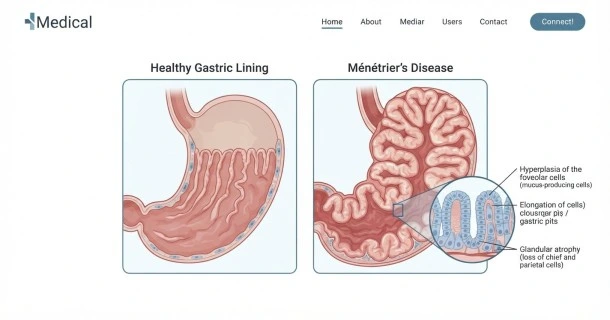
Ménétrier’s disease is an exceedingly rare, acquired gastrointestinal disorder characterized by massive overgrowth of the stomach’s inner lining. This condition causes the mucosal lining to develop giant, thickened folds that visually resemble the convolutions of a brain (cerebriform folds). Classified medically as a hyperplastic gastropathy rather than standard gastritis, it involves structural overgrowth of mucus-producing foveolar cells with minimal active inflammation.
Because these abnormally large folds leak crucial serum proteins into the digestive tract—a process known as protein-losing gastropathy—Ménétrier's disease can lead to severely low blood albumin levels (hypoalbuminemia) and subsequent systemic swelling or edema.
- To understand how this structural overgrowth alters daily life, read our comprehensive guide to Ménétrier’s Disease Symptoms.
Epidemiology and Who is Affected
Ménétrier’s disease is highly unique, with fewer than 1,000 cases documented in medical history. It primarily features two distinct clinical tracks based on age:
- Adult-Onset Track: Most frequently diagnosed in adults between 30 and 60 years of age, showing a strong statistical predominance in males. In adults, the condition typically follows a chronic, progressive course and is considered a premalignant disorder, carrying a long-term risk for the development of gastric adenocarcinoma (stomach cancer).
- Pediatric Track: A rarer childhood form exists, which behaves entirely differently. In children, it is typically an acute, self-limiting illness that resolves spontaneously within a few weeks or months without long-term structural changes.
Core Pathophysiology: What Happens to the Stomach?
In a healthy gastrointestinal tract, cells reproduce in a strictly balanced cycle. In Ménétrier’s disease, this balance is disrupted by the overexpression of Transforming Growth Factor-alpha (TGF-α). This excess signaling molecule hyper-activates the Epidermal Growth Factor Receptor (EGFR) on the stomach wall.
[Excessive TGF-α Signaling] ➔ [EGFR Hyper-activation]
│ ┌─────────────────────┴──────────────────┐
▼ ▼
[Foveolar Mucus Cell Hyperplasia] [Glandular Atrophy]
• Giant, brain-like rugal folds • Loss of parietal cells
• Severe protein leaking (Hypoalbuminemia) • Low stomach acid (Achlorhydria)
This signaling loop forces mucus-producing foveolar cells to multiply aggressively, creating giant rugal folds. Concurrently, it triggers glandular atrophy, destroying the stomach’s specialized parietal cells. As a result, the stomach loses its ability to secrete normal amounts of hydrochloric acid (achlorhydria or hypochlorhydria), drastically altering digestion and nutrient absorption.
- To dive deeper into the genetic pathways, bacterial links, and viral triggers behind this mechanism, explore our page on Ménétrier’s Disease Causes & Risk Factors.
Navigating Diagnosis and Management
Identifying this condition requires separating it from other structural stomach issues, such as Zollinger-Ellison syndrome or gastric lymphoma. Because surface biopsies can sometimes miss the deep structural modifications, specialists utilize deep mucosal evaluations alongside targeted laboratory tests.
- Learn about the endoscopies, pH testing, and tissue sampling required for confirmation in our guide to Diagnosing Ménétrier’s Disease.
Once confirmed, clinical management is highly tailored to the severity of the protein loss and the patient's cancer risk profile. Options span strict nutritional support to counteract protein wasting, advanced targeted biological therapies that block EGFR signaling, and surgical revisions.
- Discover the latest medical treatments, dietary interventions, and surgical protocols in our comprehensive breakdown of Ménétrier’s Disease Treatment.
Frequently Asked Questions
Is Ménétrier's disease a form of stomach cancer?
No, Ménétrier’s disease is not an active cancer; it is classified as a benign, hyperplastic gastropathy. However, in adults, it is recognized as a premalignant condition. The chronic structural cellular revisions within the stomach lining increase the long-term risk of developing gastric adenocarcinoma, making routine endoscopic surveillance vital.
How does Ménétrier’s disease differ from regular giant hypertrophic gastritis?
While older medical texts sometimes used the terms interchangeably, true Ménétrier’s disease is distinct because it is a gastropathy, not gastritis. Regular gastritis is defined by an influx of inflammatory white blood cells damaging the mucosa. Ménétrier’s disease is characterized by massive cellular overgrowth (hyperplasia) with minimal or no tissue inflammation.
Why does this condition cause severe swelling (edema) in the legs and abdomen?
The abnormally large, altered folds in the stomach compromise the tight junctions between epithelial cells. This allows essential blood proteins, primarily albumin, to leak continuously out of the circulatory system and into the stomach lumen to be lost in the digestive tract. Without enough albumin in the bloodstream, the body loses oncotic pressure, causing fluid to seep out of blood vessels and pool into surrounding tissues, resulting in severe peripheral edema or ascites.