
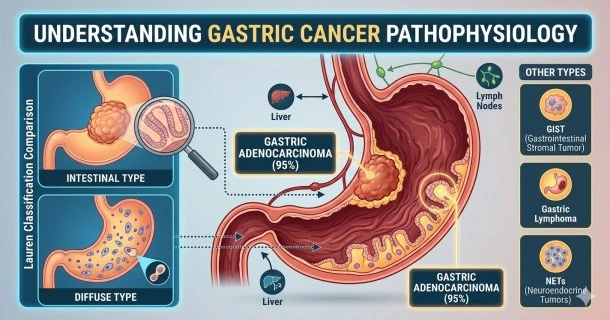
Explore stomach cancer (gastric cancer), its cellular types, and classification. Learn about gastric adenocarcinoma and the differences between intestinal and diffuse types.
Understanding Stomach Cancer (Gastric Cancer)
Stomach cancer, scientifically referred to as gastric cancer, originates when malignant cells form uncontrollably within the inner mucous-producing lining of the stomach wall. According to global oncology data from organizations like the National Cancer Institute (NCI), nearly 95% of all stomach malignancies are classified as gastric adenocarcinomas. An early stage stomach cancer overview shows that these tumors develop slowly over a period of many years, frequently beginning as microscopic cellular adjustments (dysplasia) before transforming into invasive masses.
When left unchecked, the disease advances through the distinct muscle layers of the stomach, eventually spreading via the blood vessels or extensive regional lymphatic channels to distant organs.
- To recognize the subtle, early warning signs before structural progression occurs, view our guide to Stomach Cancer Symptoms.
Gastric Cancer Types and Classification
Not all tumors inside the stomach behave the same way. Medical specialists divide the disease into distinct categories based on the specific cells where the abnormal replication begins:
- Gastric Adenocarcinoma: This represents the overwhelming majority of cases. It initiates directly inside the glandular cells of the innermost stomach lining that regularly secrete protective mucus and digestive fluids.
- Gastrointestinal Stromal Tumors (GIST): A much rarer form that begins in the specialized nervous tissue cells (interstitial cells of Cajal) located within the muscular walls of the stomach.
- Gastric Lymphomas: Malignancies that develop within the stomach's immune system tissue, frequently linked to chronic, overactive immune responses.
- Neuroendocrine Tumors (NETs / Carcinoids): Tumors arising from specialized hormone-producing cells scattered throughout the stomach's structural pathways.
Stomach Lining Cancer Pathophysiology: Lauren Classification
To guide specific treatment tracks, pathologists categorize gastric adenocarcinomas using the Lauren Classification system. This divides the disease into two primary structural variants:
[Gastric Adenocarcinoma]
│ ┌──────────────────────┴──────────────────────┐
▼ ▼
[Intestinal Type] [Diffuse Type]
• Well-differentiated cellular structures • Poorly cohesive, scattered cells
• Forms distinct, bulky tumor masses • Spreads rapidly through the stomach wall
• Strongly linked to environmental damage • Often involves signet-ring cells
• More common in older males • Higher incidence in younger populations
1. The Intestinal Type
This variant accounts for roughly 50% of cases and features well-differentiated cells that organize into recognizable glandular structures. It typically presents as a localized, bulky tumor mass in the lower sections of the stomach. The cellular progression follows an environmental sequence known as Correa's cascade, transitioning from chronic inflammation to tissue alterations before turning malignant.
2. The Diffuse Type
Accounting for about 30% to 40% of cases, this variant behaves much more aggressively. It consists of poorly cohesive, scattered cells that fail to form a single solid tumor. Instead, they infiltrate the stomach wall invisibly, occasionally causing a uniform thickening and hardening of the organ known as linitis plastica. Under microscopic evaluation, it is frequently characterized by signet-ring cells and is strongly associated with genetic anomalies.
Navigating Causes, Diagnosis, and Treatment
Managing gastric cancer requires a multidisciplinary strategy tailored precisely to the location of the tumor and its histological classification.
- To understand the genetic pathways, dietary factors, and bacterial triggers behind the disease, read our comprehensive page on Stomach Cancer Causes & Risk Factors.
- Learn about the endoscopies, staging scans, and deep tissue biopsies required to map the condition in our specialized guide to Diagnosing Stomach Cancer.
- Discover the latest surgical resections, targeted chemotherapies, and advanced immunotherapy protocols in our detailed breakdown of Stomach Cancer Treatment.
Frequently Asked Questions
What is the difference between gastric cardia and non-cardia stomach cancer?
The distinction lies entirely in the anatomical location where the tumor forms. Gastric cardia cancer develops in the top inch of the stomach, right below the gastroesophageal junction where the food pipe connects to the stomach. Non-cardia gastric cancer refers to malignancies that form in any other region of the organ, such as the main body (corpus) or the lower exit chamber (antrum).
What exactly is a signet-ring cell carcinoma of the stomach?
Signet-ring cell carcinoma is a highly specific, aggressive subtype of diffuse gastric cancer. Under a microscope, these cells look like signet rings because they are completely filled with a large droplet of mucus (mucin) that pushes the cell's nucleus flat against the outer cell membrane. This lack of cellular cohesion allows them to invade surrounding tissues rapidly.
Why is stomach cancer considered a slow-developing disease?
In its most common forms, the transition from a healthy stomach lining to active adenocarcinoma takes years. It typically progresses through long-term stages: chronic non-atrophic gastritis moves to atrophic gastritis, which can progress to intestinal metaplasia, advanced cellular dysplasia, and finally, invasive carcinoma. This long window underscores the immense value of early screening for high-risk individuals.