
Explore advanced stomach cancer medical management options. Learn about the FLOT chemotherapy protocol, HER2-targeted biologicals, and surgical gastrectomy.
Stomach Cancer Medical Management Options
Modern stomach cancer treatment is highly individualized, shifting away from a one-size-fits-all approach toward biomarker-driven precision medicine. While surgical removal of malignant tissue remains the primary pathway to clear localized tumors, systemic treatments like targeted biological therapies, advanced immunotherapies, and intensive chemotherapy protocols are deployed to maximize survival rates and prevent recurrence.
Clinical selection depends heavily on the stage of the gastric adenocarcinoma, the exact location of the tumor, and the tumor's genetic makeup.
1. Surgical Interventions for Localized Tumors
When a tumor is caught early and has not spread to distant organs, surgical resection offers the best chance for a complete cure. Depending on the size and location of the cancer, surgical teams utilize different techniques:
- Endoscopic Resection (EMR / ESD): For very superficial, early-stage cancers confined entirely to the top layer of the mucosa. The tumor is shaved out using flexible tools during an upper endoscopy, leaving the stomach intact.
- Subtotal (Partial) Gastrectomy: Performed if the cancer is localized to the lower section (antrum) of the stomach. The lower portion is removed, and the remaining upper section is reconnected to the small intestine.
- Total Gastrectomy with Roux-en-Y Reconstruction: Required if the tumor has invaded the main body or upper regions of the stomach. The entire stomach is removed. Surgeons perform a complex Roux-en-Y reconstruction, surgically bringing up a loop of the jejunum (small intestine) to connect directly to the esophagus, creating a new pathway for digestion.
To optimize staging accuracy and prevent local recurrence, surgical protocols mandate a D2 lymph node dissection, which requires harvesting at least 15 surrounding lymph nodes for pathology tracking.
2. The Perioperative FLOT Chemotherapy Protocol
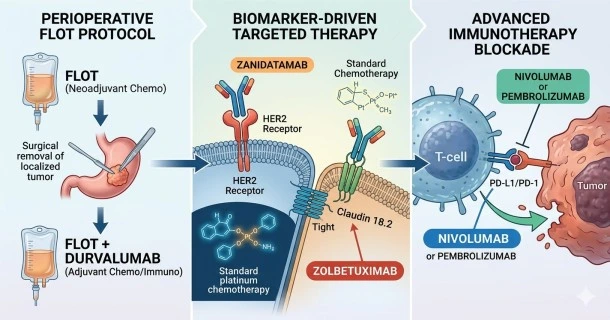
For locally advanced, resectable stomach cancers (Stages II and III), medical guidelines strongly prioritize a perioperative chemotherapy approach. This means systemic drugs are administered both before surgery (neoadjuvant) to shrink the tumor and after surgery (adjuvant) to eliminate microscopic cancer remnants.
The undisputed clinical gold standard for fit patients is the FLOT chemotherapy protocol, a intensive four-drug combination regimen:
- Fluorouracil (5-FU)
- Leucovorin (Folinic Acid)
- Oxaliplatin
- Taxotere (Docetaxel)
According to international guidelines, adding the immune checkpoint inhibitor durvalumab to the perioperative FLOT regimen (D-FLOT) is the preferred approach for eligible patients. This combination dramatically improves event-free and overall survival rates compared to chemotherapy alone.
3. Biomarker-Targeted and Biological Therapies
For advanced, recurrent, or metastatic gastric cancer, mandatory molecular testing is performed at the time of diagnosis to screen for targetable receptors:
[Advanced Gastric Cancer Biomarkers]
│
┌───────────────────┼───────────────────┐
▼ ▼ ▼
[HER2-Positive] [CLDN18.2-Positive] [PD-L1 / MSI-H]
• 1L: Zanidatamab + • 1L: Zolbetuximab + • 1L: Nivolumab or
Tislelizumab + Chemo Platinum-Fluoropyrimidine Pembrolizumab + Chemo
• 2L:Trastuzumab Deruxtecan • Targets Claudin 18.2 protein • Re-activates T-cells
Targeted Therapies for HER2-Positive Gastric Cancer
If a tumor overexpresses the Human Epidermal Growth Factor Receptor 2 (HER2), first-line treatment protocols introduce highly specialized monoclonal antibodies. Current guidelines recommend a triplet regimen of the newer HER2-directed agent zanidatamab combined with the immunotherapy tislelizumab and standard chemotherapy. If zanidatamab is unavailable, the classic anti-HER2 agent trastuzumab paired with chemotherapy remains a trusted first-line standard. For second-line treatment, the antibody-drug conjugate trastuzumab deruxtecan is deployed.
Claudin 18.2-Positive Stomach Cancer Treatment
A critical breakthrough in targeted oncology is the targeting of Claudin 18.2 (CLDN18.2), a tight-junction protein frequently overexpressed in stomach tumors. For patients who test positive for this marker, the biological drug zolbetuximab is combined with platinum-fluoropyrimidine chemotherapy, significantly delaying disease progression.
Immunotherapies for PD-L1 and dMMR/MSI-H Tumors
If tumors exhibit high Programmed Death-Ligand 1 (PD-L1) expressions or present as Mismatch Repair Deficient (dMMR/MSI-H), checkpoint inhibitors like nivolumab or pembrolizumab are integrated into first-line chemotherapy. These drugs block the checkpoint pathways that cancer cells use to hide, uncloaking the tumor so the body's natural T-cells can aggressively attack it.
Make sure to double-check the physical label of any prescribed oncology drug or supportive medication to confirm names, strengths, and handling parameters are strictly accurate.
Frequently Asked Questions
What is HIPEC, and when is it used for stomach cancer treatment?
HIPEC stands for Hyperthermic Intraperitoneal Chemotherapy. It is a specialized, regional treatment utilized during surgery for advanced cases where the cancer has spread slightly to the lining of the abdominal cavity (peritoneum). After the surgeon removes all visible tumor masses, a heated, high-dose chemotherapy solution is circulated directly inside the open abdomen for up to 90 minutes to kill remaining microscopic cancer cells locally while minimizing systemic side effects.
How do lifestyle and nutrition change after a total gastrectomy?
Living without a stomach requires permanent, structural adaptations. Because the holding chamber is gone, patients must eat 6 to 8 small, nutrient-dense meals a day rather than three large meals, and limit simple sugars to avoid "dumping syndrome" (rapid fluid shifts causing dizziness and cramping). Additionally, because the stomach's parietal cells are gone, the body can no longer absorb dietary vitamin B12, making lifelong vitamin B12 injections or high-dose supplements mandatory to prevent severe anemia and nerve issues.
Why is testing for DPD deficiency required before starting stomach cancer chemotherapy?
Before administering fluorouracil (5-FU) or capecitabine—which form the backbone of the FLOT and other gastric cancer regimens—specialists routinely order a test for Dhydropyrimidine Dehydrogenase (DPD) deficiency. DPD is the primary liver enzyme responsible for breaking down these specific chemotherapy drugs. If a patient has an undiagnosed genetic deficiency in this enzyme, the chemotherapy can quickly build up to toxic, life-threatening levels in the bloodstream, requiring immediate treatment adjustments or alternative drug selections.