
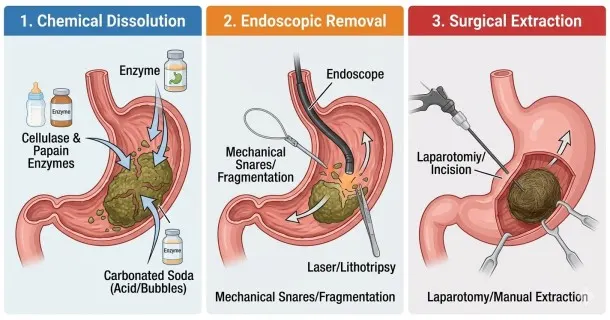
Discover how doctors treat and remove gastric bezoars. Learn about chemical dissolution, endoscopic fragmentation, and surgical removal options.
Bezoar Treatment: Dissolution and Removal Options
Because a bezoar represents a hard, physical obstruction within the gastrointestinal tract, treatment plans focus entirely on breaking down or extracting the mass safely. The choice of therapy depends heavily on the size of the block, where it is located, and whether it consists of plant fibers, compacted medications, or hair.
The Main Interventional Pathways
Gastroenterologists and surgeons utilize three primary methods to clear a gastric bezoar mass:
1. Chemical Dissolution (Non-Invasive Therapy)
For small to moderate plant-fiber masses (phytobezoars), doctors often attempt to chemically dissolve the blockage before resorting to surgical tools.
- Cellulase and Papain Enzymes: Patients may be prescribed heavy, concentrated doses of digestive enzymes or meat tenderizers containing papain or cellulase. These work by actively snipping and dissolving the tough plant walls holding the mass together.
- Carbonated Beverages: In many clinical settings, drinking or flushing the stomach with large volumes of Coca-Cola has proven highly effective at breaking up phytobezoars due to its acidic profile and carbon dioxide bubbles.
2. Endoscopic Fragmentation and Removal
If chemical dissolution fails or if the mass is too dense, an upper endoscopy is deployed as a minimally invasive removal option.
- The Procedure: While the patient is sedated, a specialist guides an endoscope down into the stomach cavity.
- Mechanical Breakdown: The doctor uses specialized tools—such as wire snares, forceps, or laser lithotripsy attachments—passed through the tube to manually grip, cut, and break the mass into tiny fragments. These smaller pieces can then be suctioned out or allowed to pass safely into the bowel.
3. Surgical Extraction (Laparotomy)
Large, dense hairballs (trichobezoars) or masses that have caused a complete intestinal blockage cannot be dissolved or safely chopped up with an endoscope tube.
- Open or Laparoscopic Surgery: In these cases, a surgeon performs an operation (an enterotomy or gastrectomy) to open the stomach or intestinal wall and manually remove the intact mass. Surgery is mandatory if a friction ulcer has ruptured the stomach lining.
Post-Treatment Prevention Strategies
Once a bezoar is fully removed, altering habits is essential to stop it from returning:
- Dietary Modifications: Patients with poor stomach motility (gastroparesis) must transition to a low-fiber, low-cellulose diet, limiting fibrous foods like celery, persimmons, and tough skins.
- Prokinetic Medications: Doctors may prescribe motility-boosting drugs like metoclopramide to speed up stomach emptying and prevent food particles from sitting stagnant.
- Psychiatric Follow-Up: For individuals recovering from a hair bezoar, target behavioral therapy is crucial to treat underlying hair-pulling or hair-eating impulses.
Frequently Asked Questions (FAQs)
Can a hairball (trichobezoar) be dissolved using Coca-Cola or enzymes?
No. While chemical dissolution using carbonated sodas or cellulase enzymes works well on plant-fiber phytobezoars, it has absolutely no effect on human hair. Hair is made of a tough protein called keratin, which resists chemical breakdown and must be removed through an endoscopy or surgery.
What are the risks of using meat tenderizer enzymes to dissolve a bezoar?
Using meat tenderizers containing papain must be supervised carefully by a doctor. If a patient has an undiagnosed stomach ulcer caused by the friction of the bezoar, the harsh protein-digesting enzymes can attack the raw stomach lining, increasing the risk of severe gastrointestinal bleeding or an abdominal wall perforation.
How long does an endoscopic bezoar removal procedure take?
An endoscopic fragmentation procedure typically takes between 30 to 90 minutes, depending on how large and hard the mass is. Because the doctor must carefully chop the block into small fragments without scratching the surrounding esophagus or stomach walls, it requires deliberate, precise movements under sedation.
Why do some drugs like glucagon get used during treatment?
If a doctor suspects a small piece of a broken bezoar or a foreign object is stuck in a narrow section of the digestive tract, medications like glucagon can be administered. Glucagon temporarily relaxes the smooth muscles of the GI tract wall, widening the channel to let the object pass safely into the bowel.