
Learn how stomach polyps are treated based on their type. Explore endoscopic polypectomy, monitoring small polyps, and H. pylori antibiotic therapies.
Stomach Polyps Treatment: Management and Removal
The treatment for stomach polyps (gastric polyps) is completely customized based on the specific cell type, overall size, and cancer risk identified during your diagnostic biopsy. While some small, benign polyps require no medical intervention at all, others must be removed promptly to prevent the development of gastric cancer.
The Four Main Treatment Pathways
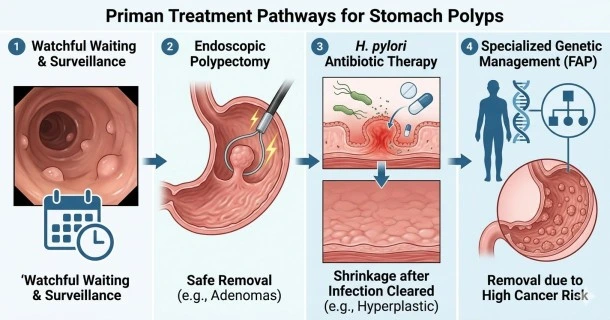
Gastroenterologists categorize gastric polyp treatments into four primary pathways:
1. Watchful Waiting and Active Surveillance
If your biopsy confirms that you have small polyps that are not adenomas (such as small fundic gland polyps), you may not need active treatment.
- Routine Monitoring: These types rarely become cancerous and cause zero physical symptoms.
- Follow-Up: Your specialist will simply schedule periodic follow-up endoscopies to monitor their size and ensure they are not growing or causing hidden problems.
2. Endoscopic Polypectomy (Surgical Removal)
For larger tissue masses or polyps with any precancerous potential, physical removal is the medical gold standard.
- The Procedure: Most stomach polyps are cleanly snipped and removed during a standard upper endoscopy.
- Target Groups: Doctors routinely remove all gastric adenomas because they are known precursors to stomach cancer. Large hyperplastic polyps (over 2 centimeters) are also removed immediately.
3. Antibiotic Therapy for H. pylori Eradication
If your path lab report reveals that your polyps are hyperplastic and triggered by chronic inflammation from a Helicobacter pylori (H. pylori) infection, medication is the primary fix.
- The Regimen: Your physician will prescribe a targeted course of antibiotics alongside acid-suppressants spanning several weeks.
- The Result: Completely eradicating the H. pylori bacteria eliminates the root inflammation, causing these specific hyperplastic polyps to shrink, disappear, and stop recurring entirely.
4. Specialized Care for Genetic Syndromes (FAP)
Patients diagnosed with hereditary conditions like Familial Adenomatous Polyposis (FAP) face unique challenges. Because FAP causes hundreds of polyps to carpet the digestive tract, surgeons carefully remove them because of their incredibly high genetic link to cancer progression.
Frequently Asked Questions (FAQs)
Do all stomach polyps need to be removed?
No. Small, benign polyps (like typical fundic gland polyps under 1 cm) that do not cause any physical symptoms or bleeding do not require active removal. They can be safely monitored over time using routine, scheduled upper endoscopies.
What happens during an endoscopic polypectomy?
An endoscopic polypectomy is a minimally invasive outpatient procedure. While you are resting comfortably under sedation, the gastroenterologist slides specialized wire loops (snares) through the endoscope channel to grasp, cut, and seal the base of the polyp using mild electrical heat. The procedure is typically painless and takes less than 30 minutes.
Can stomach polyps grow back after they are treated or removed?
Yes, stomach polyps can occasionally recur if the underlying trigger is not fully resolved. For example, if an H. pylori bacterial infection is not completely cleared with antibiotics, or if a patient continues taking high doses of proton pump inhibitor (PPI) medications, new polyps may form in the future.
How long does it take for antibiotics to get rid of H. pylori polyps?
A typical antibiotic eradication regimen for an H. pylori bacterial infection lasts between 10 to 14 days (up to several weeks). Once the active infection is fully eliminated, it may take a few months for the chronic stomach inflammation to settle and for the hyperplastic polyps to completely regress and disappear.